
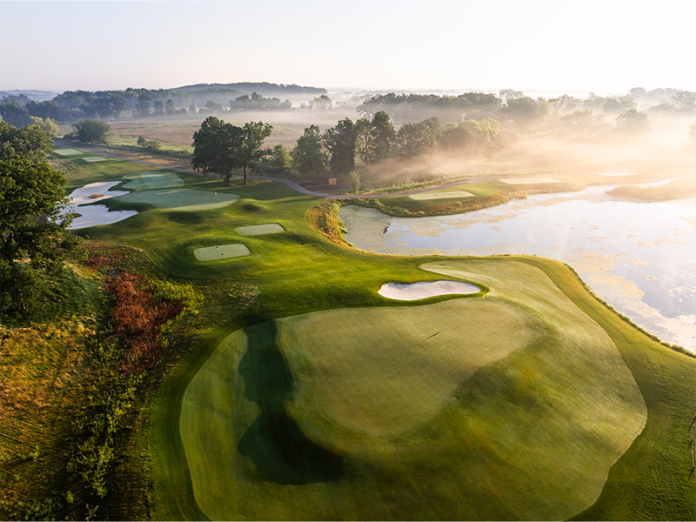

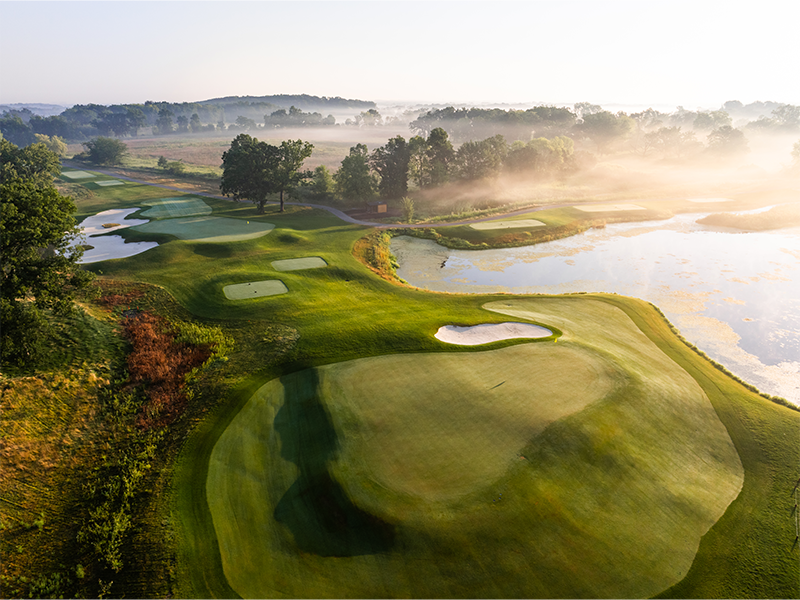
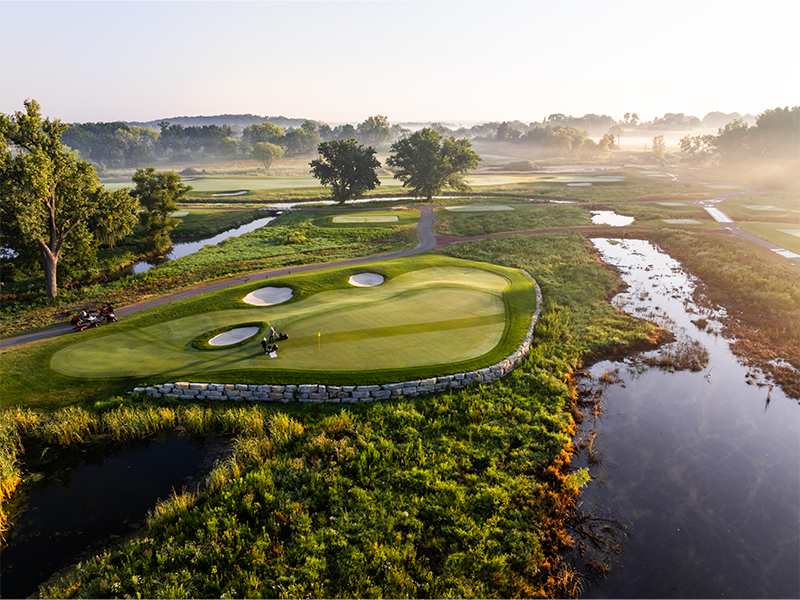
If ever there was proof that a clean environment is necessary for business to thrive, or that golf and nature fit together like hand and glove, it’s TPC Wisconsin, the rebranded version of the former Cherokee Country Club. Cherokee’s picturesque successor has only been open for one year, but its ongoing transformation into the 30th TPC (Tournament Players Club) network golf club in the world, financed by Wisconsin Golf Hall of Famer Dennis Tiziani, is an unfolding story worth knowing.
Starting in 2025, TPC Wisconsin, already designated as a PGA tournament-level course, will become the new home of the PGA TOUR Champions’ American Family Insurance Championship. The championship, created in 2016 by American Family Insurance and PGA TOUR Champion and player Steve Stricker, is scheduled for next June 6–8 and seeks to build off the foundation established at its first home, University Ridge Golf Course, where it helped raise over $17 million for the American Family Children’s Hospital and other charities. Additional events, such the Badger Invitational in fall 2025, have been scheduled at TPC Wisconsin, but before the course could host dues-paying club members and future events, more than two years of environmental renovation work had to be completed.
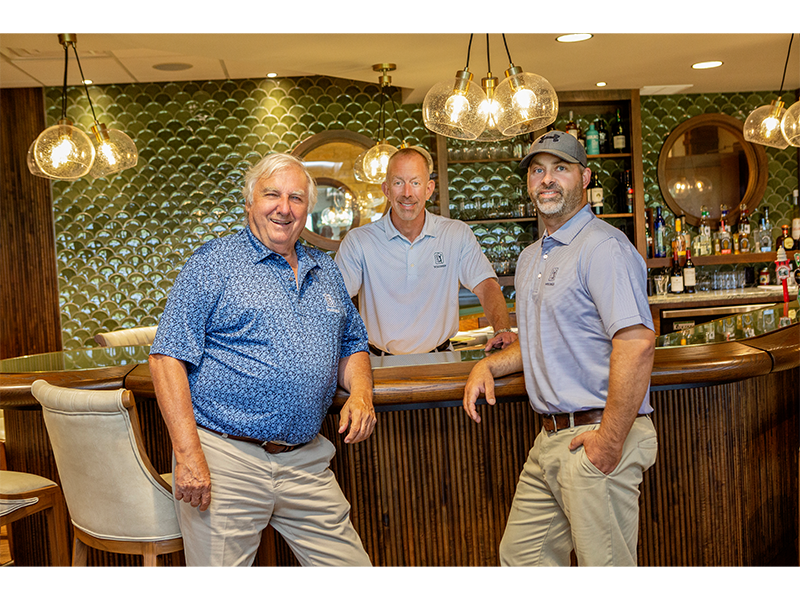
The result is a stunning resurrection of a property that promises to benefit Wisconsin for generations to come. To discuss the environmental metamorphosis, we spoke to Dennis Tiziani, owner of TPC Wisconsin, former University of Wisconsin golf coach, and a former PGA Tour player; Dave Olesczuk, executive vice president of Cherokee Park Inc., which owns the golf course property; Eric Leonard, the course supervisor; and Jeff Kraemer, vice president and principal scientist with Heartland Ecological Group, which played a key role in reinvigorating the property’s natural appeal.
Most everything related to wetland restoration and environmental remediation was handled by Heartland, which led the permitting efforts for the Wisconsin Department of Natural Resources (DNR), which took the baton from the federal Army Corps of Engineers. Additional permits were required by Dane County for floodplain and erosion control. “Certainly, the end result of this is going to be a significant environmental improvement of that area,” Kraemer says. “It’s definitely a pretty cool area between where the Cherokee Marsh intersects with the Yahara River, and then you have the golf course in between the two areas. All of this work that he [Tiziani] has done is going to do nothing but help protect the marsh and help enhance the water quality downstream.”
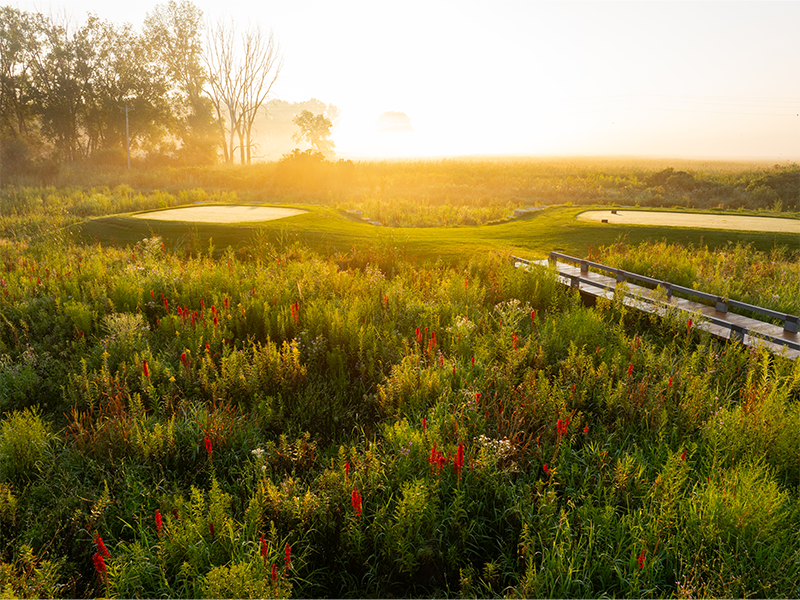
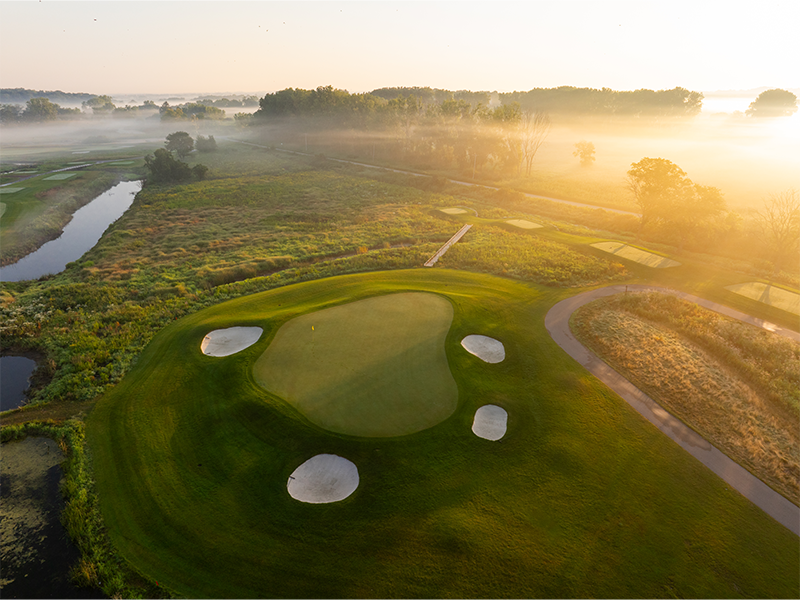
The 150-acre property abuts Cherokee Marsh and is part of that marsh system — the golf course itself contains about 35 acres of wetlands. Restoring the wetlands on the course was job one in Tiziani’s $20 million (and counting) investment in renovating and redesigning the course. Previous improvements were overcome by various circumstances, and it became clear that incremental changes were not going to get the job done.
“That was how it all started, environmentally,” states Tiziani. “The facility we had was old and if we had let it go, even today, it would turn to marsh … We made the decision to do it all or not at all, and it was environmentally sensitive to begin with.”
More sustainable course
According to Kraemer, who notes that Tiziani went well beyond what was required by permit, the process began in summer 2020 — as the COVID-19 pandemic dragged on — and one of the first things Heartland Ecological had to do was a wetland delineation. That assessment involves going out on site and formally mapping where the boundary of the wetland starts and ends. That assessment determines the design of which wetlands can be voided and which wetlands cannot, and to quantify any impacts that may be proposed.
The number of permits required some patience on Tiziani’s part, Kraemer notes, even though only two of the 35 acres of permanent wetland impact required a wetlands mitigation permit. Tiziani spent about $250,000 to purchase mitigation credits to offset that impact. “He was very patient with it,” Kraemer states. “Dennis really wanted to do the right thing with bringing back the ecology that surrounds this golf course and really make it an asset in the future. We were basically restoring or enhancing about 35 acres of wetlands on the golf course. None of that was required by any regulatory agency.”
Once the initial wetlands assessment was done, contractors were brought in to excavate and dredge narrow waterways and ponds to mine for the type of glacial sand that was ultimately used to reconstruct the fairways, a task that also improved the quality and flow of the waterways because of the accumulated sediment and organic material that was also removed. Much of the vegetative clogging was caused by the growth of non-indigenous and invasive plant species such as cattails and reed canary grass, which are tall and dense, choke out everything below them, block sunlight and nutrients, and limit the growth and diversity of native plants.
Kraemer describes the result as a stagnant system that prevented water flow through culverts, which were not working as they should to accommodate the movement of aquatic life. As a result, the northern pike, large-mouth bass, and other fishery habitat that once moved freely were no longer found. If the culverts are working properly, aquatic life can pass through even when water levels are low.
“About 90% of the vegetative cover in those wetlands were pretty much three species — invasive cattails, reed canary grass, and phragmites or giant reed grass — all really bad invasives, and that’s what these wetlands primarily consisted of,” Kraemer explains. “So, very low diversity, real thick, and hard — not the ideal habitat for wildlife.”
Heartland Ecological Group is in year two of a three-year process, and the work will continue after that to prevent a reintroduction of invasive species. According to Kraemer, whose company developed the new planting plan, the process of establishing and restoring wetlands to a native plant community takes many years. During those years, Heartland will plant thousands of native plants and actively manage the area to keep the invasives from coming back.
Each waterway was excavated to a four to five-foot depth, and the ponds were excavated to a depth of about 20 feet at their deepest point, which stands to benefit the entire local system. “The water flows in and out of this area better and in a cleaner fashion,” notes Olesczuk. “That goes into the Yahara River and Lake Mendota, ultimately.”
Heartland spent almost two years — part of 2020 and all of 2021 — on the preparation process of restoration, which is control and removal of the invasives. Some of that was through cutting, burning, and careful herbicide application, and once Heartland had good control of the invasives, it used various native seed mixes to reestablish sedge meadow, native emergent marsh, and wet meadow (aka wet prairie) plants. “We are in the second growing season since it was seeded, and we’ve seen very good results,” Kraemer states. “So far, we have more than 50 native plant species establishing out there now with very low cover of the invasive species that we were trying to eradicate to begin with.”
A primary reason the remediation work will continue is that the seed bank buildup of those invasives has been accumulating for 75 years, and so there’s still a lot of seed coming in from the invasives. “The idea, when you’re trying to establish these native wetland communities, is to foster the natives so they have the opportunity to come in and create enough cover that limits the invasive species coming back,” Kraemer explains. “So, these first three to five years of establishment is a very aggressive management approach to control those invasives before they get a foothold again while we wait for these native species that have come in slowly over time.”
This constant adaptive management is meticulous work that requires Heartland’s ecologists to be on the course at least one week of each month, going through the wetlands on foot and monitoring the waterways as well. If they use a herbicide to treat individual invasive species, they must be careful to avoid off-target damage to native species they are trying to establish.
“There’s definitely a short window of opportunity,” Kraemer says. “We have six months, and during those six months, there are a lot of days where you can’t do the work. And it’s wetlands, so sometimes it’s even too wet to get in there, especially as rainy as it’s been this year. There are areas that are difficult to get into to do the work.”
The waterway drains right into the Yahara River, and there already are signs that old aquatic life has returned. On the course, it’s not unusual to see the return of sandhill cranes, plus green heron and other species of birds who find the new environment more accommodating.
Kraemer notes that the project triggered a number of different regulatory statutes. The dredging of public bodies of water requires a DNR permit because that agency regulates waterways, wetlands, and endangered and threatened species. The replacement of failing culverts with either larger culverts or clear span bridges required a permit, and the expansion of the golf course into edges of wetlands required a permit.
Even the introduction of other earthy elements, such as large logs and stumps from old trees that were placed in waterways and attract turtles, required a permit. “They are as round as a table floating out there,” Leonard says, “and sometimes there will be 20 or 30 turtles sitting on those. It’s pretty cool.”
The golf course operation pumps water out of ponds and sometimes a well for irrigation of the wetland plantings and the golf course, and while that activity did not require a permit when it began decades ago, Heartland found it had not been grandfathered in. So, once the project opened the door to regulatory review, a water withdrawal permit was required, and that was a lengthy, complicated process because the company had to get a sign-off from every downstream user of the Yahara and Rock Rivers to the southern state line. Any entity that has a dam or any other structure on the rivers that might have concern about withdrawing water upstream — about one dozen in all — had to give their approval.
The number of sprinkler heads on the course has grown from 300 to 1,850, but the newer versions can be applied more efficiently, pumping out 35–40 gallons of water per minute compared to 50–70 gallons per minute for the older models. A large portion of that water will help care for the new native plants.
Designs on golf
With that, the redesign of the course could begin with the earthwork process — fine grading, grassing, and additional planting that will have long-term effects and continue to evolve. Soil borings were done at the urging of Steve Wenzloff, senior vice president of design for the PGA Tour, who had helped build a golf course in Minneapolis 25 years ago and figured the same glacial sand he found there would be found in Madison. Wenzloff’s hunch was correct, and that glacial sand now helps TPC Wisconsin’s fairways drain properly, giving the golf course the firm, fast conditions that test even the best players.
Having the glacial sand on-site saved a lot of trucking expense — otherwise thousands of tons of sand would have been brought in. Although sand was trucked in from Ohio for the bunkers, having on-site glacial sand for the fairways reduced the project’s carbon footprint.
The design received considerable input from Wenzloff and Stricker, who in 2021 captained the United States Ryder Cup team to a record victory and considers TPC Wisconsin to be his home course. They got a big assist from the weather gods and the general contractor, Wadsworth Golf Construction Co.
In early 2022, the entire golf course was plowed over with heavy equipment that could operate better on frozen ground than on soft, wet marsh. “It looked like a bomb went off,” recalls Olesczuk. “Everything was plowed over, and then they rebuilt it. It was fortunate from a weather standpoint because it was a very clean winter, which allowed us to get the heavy trucks out and do their work because in other winters, we would not have been able to do that.”
Wenzloff, who researched Lake Mendota dam levels, determined that groundwater levels had been rising. He put together a report that determined the golf course had to be raised — the fairways were raised two feet, the greens anywhere from 5–8 feet — and certain vegetation had to be removed so that canals and waterways could function the way they once did. The site was raised with an organic and clay layer and capped off by the sand, thereby transforming TPC Wisconsin into a fun, challenging upland course.
Seeding and sodding work began and the last hole of the new course was finished by October 2022. Another relatively mild winter allowed for the grass to grow well heading into the August 2023 reopening. The course, which features roughly an equal number of water hazards and sand bunkers, challenges players with its mounds, undulating surface contours, and occasional water that comes into play near the green.
In Tiziani’s view, the course forces players to pick their spots. “For regular play, I have a lot of places to put pins,” Tiziani notes. “When I have tournaments of any kind, I’ve got places where there will have to be some thinking going on in order to putt here.”
While challenging, Stricker and Tiziani also emphasized the playability of the course, as in playable for everyone. About 99% of the people who play the course will be club members, so it was important to design a course, including multiple tee boxes, that’s playable for everybody from a tour professional to a 25 handicap. That’s a delicate balance, but it can be achieved with features such as multiple tee boxes on each hole.
In great measure, Stricker’s appreciation for the short game influenced the course design. There is something for every level of golfer, especially a green’s complex that players can play a number of shots into, and Olesczuk, a former University of Wisconsin golfer, appreciates how TPC Wisconsin’s different variables test everyone’s golf game. “If your short game isn’t that great, you can putt it up there [on approach],” Olesczuk says. “Otherwise, you can play pitch and runs or you can flop them on. It pinpoints every part of your game, which makes it a fun golf course.”
In terms of the course layout, designers were limited on what they could do because of the wetlands, so those who remember the Cherokee Country Club course will see a similar line. To help the new course flow better, hole 15 became whole 10, hole one became hole 15, and hole 10 became hole one. “We shifted a few holes … otherwise, the rest of the layout stayed,” Leonard says, “but obviously we moved up tee boxes, so the tees shifted one way or the other, and the greens moved in a certain direction.”
Not only did tee boxes move, there are more of them — at least five per hole, with some having more — to accommodate different playing abilities. Tiziani sees most of the future growth of club membership coming from the expanding women’s market. The club will accommodate overall growth with amenities such as a club store with brand name apparel, an ecommerce site, and the Steve & Nicki Stricker American Family Insurance Learning Center, which is under development for newcomers and aspiring young golfers to receive coaching from seasoned golf instructors.
Stricker’s hope for the learning center is that it serves as a foundational piece for the local golf community, especially families and kids. “It’s going to be an opportunity for people of all races, of all genders, and all ages to come here and try to get what you need to improve your lifestyle,” he says, “and not only in golf but off the course as well.”
Stricker, who is Tiziani’s son-in-law, calls TPC Wisconsin his father-in-law’s “baby, desire, and dream,” but he had a great deal to say about the course design. On each hole, Stricker and Wenzloff incorporated elements of golf courses they admire around the world. “The recall that they both have on the various golf courses they’ve seen, and their designs, is crazy,” Leonard says. “They were going back and forth with, ‘Do you remember this hole at this course?’ So, they would pick a spot such as hole 16 … The bunkers are placed right before the green on the left to mimic [TPC] Sawgrass, hole 10. So, they incorporated parts of golf courses, but there was never any intention to duplicate an entire hole.”
Kraemer notes that the DNR was out earlier this season and pleased about the progress of wetlands restoration, and they aren’t the only ones that have noticed. Olesczuk has hosted PGA tournament directors, representatives from Golf Week and Golf Digest, and golf course photographers who marvel at how far the course has come in a few years. “To a person, they say the same thing: ‘I can’t believe you’ve only been open for a year.’ They are very impressed with how far along everything is, and it will continue to get better.”
While some concern was raised over the number of trees removed, course operators note that many of the trees taken down were diseased with the emerald ash borer or at the end of their life cycle. About 75 healthy trees, many of them hickories and maples, were preserved. According to Leonard, this may actually be more of how the course looked 50 years ago, before it became overgrown.
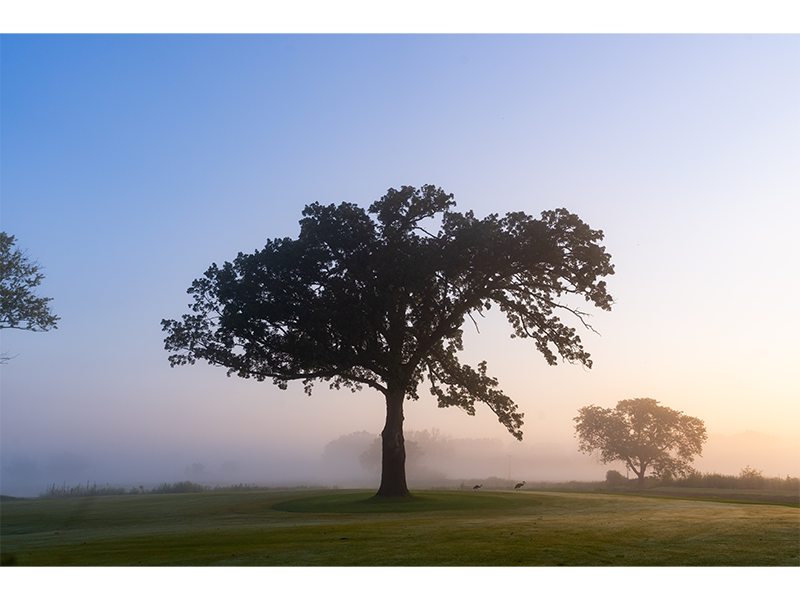
Among the survivors is a 150-year-old oak tree that was once on the right side of the fairway on hole 9, and now it’s just left of center, presenting a different challenge for would-be shot makers. Unlike the famed Eisenhower tree at Augusta National in Georgia, which was lost in an ice storm, or the cypress trees in the 18th fairway at Pebble Beach Golf Links in California, one of which was lost in a gusty windstorm, the TPC Wisconsin oak is still standing. “And so, it’s neat with the way it’s set up,” Olesczuk says. “I’m glad we kept it.”
The 19th hole
TPC Wisconsin was judged to be the second best golf course renovation of 2024 by Golf Inc., and Tiziani expects the course to receive the highest level of Audubon certification. “It’s more environmentally sensitive and pleasing,” states Tiziani, clearly happy with the return on his investment. “I don’t know any place like this.”
Documenting a transformation
A 34-minute documentary video has been produced that illustrates the considerable work that went into restoring wetlands on TPC Wisconsin and the redesign of the course. It features contributions from Dennis Tiziani, Steve Stricker, Steve Wenzloff, Jeff Kraemer, and others who offer testimony to the comprehensiveness of the restoration work on the golf course.
Segments of the video can be found at the following link:

