

From the pages of In Business magazine.
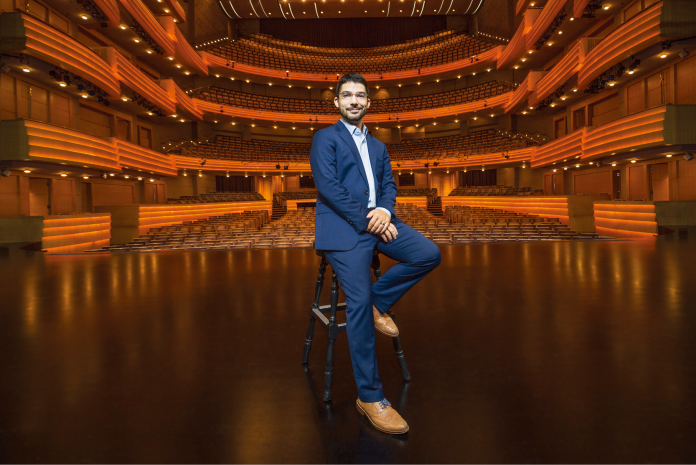
Jonathan Solari, the new CEO of Madison Ballet, is a worldly, insightful theater-maker and arts administrator who founded two nonprofit theatre companies in New York City by the time he was 27. Now 33, he aims to bring the house down in Madison, but for reasons we would not suspect.
While in the Big Apple, his New Brooklyn Theatre was celebrated by both The New York Times and the Wall Street Journal for pushing the limits and rallying communities around important causes.
Solari’s theatrical and societal impacts already extend beyond the stage. Under his leadership, the group’s performance of an Edward Albee play inside a Brooklyn, New York hospital was credited with saving a bankrupt health system.
In West Virginia, he organized a community theater performance on a floating stage outside the state capital after a chemical spill affected the water supply.
He also partnered with Harvard University to perform “a classic Chekhov” play on a 125-year-old farm targeted for redevelopment in Turkey.
Solari, a self-described nomad who has lived in at least eight U.S. states, has planted his creative roots in Wisconsin, his wife’s home state. As Madison Ballet prepares to launch its forthcoming season, including The Nutcracker in December and Shakespeare’s A Midsummer Night’s Dream next spring, Solari talks of eliminating — rather than raising — the theater curtain to promote arts for all.
| “I’ve met many business leaders here with backgrounds in dance.” — Jonathan Solari, Madison Ballet |
IB: What do you hope to accomplish at Madison Ballet?
Solari: In New York, I focused on accessibility in the arts, and that’s the vision I have for the Madison Ballet. I want to remove all barriers to the arts. We have incredible resources here with Overture and the future Youth Arts Center. It’s critical that they be available to everyone regardless of socio-economic status or geography.
IB: What specifically can Madison Ballet do toward that end?
Solari: For one, we are formalizing a tuition-assistance fund for our ballet school and exploring options so transportation is not a barrier to students taking classes.
IB: What do you want the business community to know?
Solari: That many lifelong skills gained by participation in the arts are easily transferable outside of the arts — accountability, discipline, creative thinking, and collaboration. As a creative collaborator, I’m always seeking ways to bridge the business community and the Madison Ballet. I’ve met many business leaders here whose backgrounds included some form of dance.
IB: Are you a dancer?
Solari: [Laughing] Thankfully not! I’ve directed opera and plays and understand the arts world, but what our dancers do is absolute magic to me.
IB: Ballet is beautiful, but how do you interest new audiences?
Solari: Relevance. The whole medium is at a turning point. We see an artist like Misty Copeland — who has broken through barriers and inspired multiple generations — question who art is for, when, and where.
(Continued)
IB: Tell me something about you that would surprise people.
Solari: I performed a puppet show by myself in Minsk, Belarus!
IB: How did that come about?
Solari: In New York, I had met Václav Havel, a playwright who became the first president of the Czech Republic. He told me that the most important performances in the world were happening in Belarus because it’s a dictatorship and there’s no right to assemble or freedom of speech.
After the Belarus Free Theater agreed to let me visit, I performed on the outskirts of Minsk with a hand-carved, life-size wooden puppet. I don’t speak Russian, but a friend transcribed a piece I’d written.
There I was, sitting in a house with amazing artists and dissidents, when suddenly a crowd of Belarusian teens and young adults shows up from nowhere.
Turns out they’d all received a text instructing them how and where to get to our location, which bus to take, and which person would lead them to us. Had the KGB found out, the performance would have gotten busted up. It was wild!
IB: What was your takeaway from that?
Solari: That if people can make performances happen and understand the value of performance under those circumstances, we can certainly do a better job of celebrating what we have here!
Click here to sign up for the free IB ezine — your twice-weekly resource for local business news, analysis, voices, and the names you need to know. If you are not already a subscriber to In Business magazine, be sure to sign up for our monthly print edition here.

