

The future of business always is a hot topic, and never more than now with technologies such as artificial intelligence driving the discussion. AI and its utility for small businesses, and the latest trends in workforce development, will be explored the morning of Nov. 6 during IB’s first annual Future of Business Summit.
The program will be held from 8 a.m. to noon at the Madison Marriott West, 1313 John Q. Hammons Drive. During the summit, national and local experts will convene to discuss opportunities and challenges facing business operators in the two main subject areas — AI and its applications for small businesses, and the latest in workforce development.
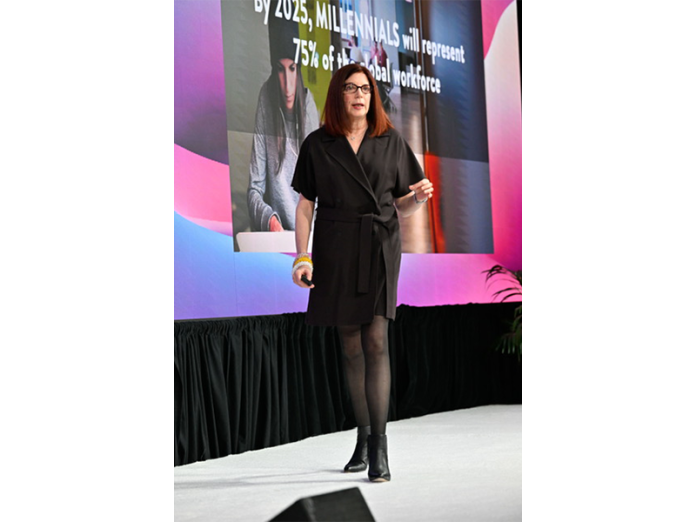
The event will begin with futurist Anat Baron delivering an interactive keynote presentation titled “Navigating the High-Speed World of Human + AI.” Baron, a former Hollywood executive and producer and a former business executive with Mike’s Hard Lemonade, will explain why she disagrees with the real-life plots that have AI and robots creating a dystopian nightmare where machines make humans irrelevant.
Baron not only disagrees with that plotline, she believes business operators should embrace AI, especially generative AI, or be left behind. Combined with human decision-making, the value of this still emerging communication technology can be transformative, not only in predicting and adapting in real time to meet customer needs, but also in freeing up employees from tedious, time-consuming tasks and enabling them to devote more time to activities that drive business value.
With all the talk about AI creating a dystopian future, Baron notes that AI has a utopian feature. “When you look at AI and the possibility of AI, it could be either [positive or negative],” Baron notes. “It could be the greatest thing that ever happened to humanity because it does the one thing that we’re not talking enough about, which is we give up all the tasks that a computer or an algorithm or a robot can do, and it gives us back the one thing that we all complain that we don’t have enough of, which is time. That’s the utopian version of it.”
While AI’s business use cases are still developing, Baron’s keynote also will include examples of the ways businesses are using AI to enhance productivity and the AI tools they are using to leverage the technology.
Expert paneling
Panel discussions will follow the keynote presentation. The AI panel will be led by Dr. Yi Liu, an assistant professor in the marketing department at the University of Wisconsin–Madison School of Business.
Dr. Liu earned a bachelor’s degree in information management and information systems from Tsinghua University in Beijing, China, and his Ph.D. in marketing from the Wharton School at the University of Pennsylvania. Among his main research interests are building theoretical models about technology, including AI and online platforms, to study their impact on businesses and their customers.
One theory about generative AI and business is that it could have a homogenous effect on competitors in the service markets, whether it be consulting, legal, marketing, or even medical services. “First off, we can produce some content automatically,” Liu explains. “So, maybe the quality of such content may be not as good as the top-tier providers — the human providers — but maybe it can be better than the bottom-tier providers, the human providers. So, it can provide something in the middle. That’s one angle.
“Another angle that we want to focus on is that AI tools can make the output more homogeneous,” he adds. “If you think about AI tools, they are trained in similar data sets, and they are using similar algorithms such as transformer [used by Open AI’s ChatGPT and other tools] or those kind of neural networks. So, basically, they can provide more similar outcomes.”
Wide, wide workforce
Some of the workforce trends that spun out of the COVID-19 pandemic — quiet quitting, for example — are losing some steam as employers make the adjustments necessary to mitigate them. That said, the Madison, Wisconsin, and American workforces are becoming more of a telecommuting workforce, says Tom Ward, a panelist and vice president and chief human resources officer for Quartz Health Solutions, a medical insurance company serving the Wisconsin market. Quartz has gone from having 25% of its workforce telecommuting before the pandemic to about 65% today.
Part of the reason for that is Quartz is in a position to, and is willing to hire, people in different regions of the country, and it now has employees in 18 states. But wherever employees work remotely, Ward notes that employers must engage with those telecommuting employees in the same fashion they engage with those who regularly come to the office, and they must be ready to navigate the various labor laws in the states where they have remote employees because different states do things differently.
To the extent that it can, Quartz has budgeted to bring employees back to the office selectively throughout the year to continue to drive that engagement. “But I think, like a lot of organizations, we’re still contending with optimizing that opportunity,” Ward states. “From our perspective, it [telecommuting] is here to stay, particularly in the insurance industries.”
Other topics that will be explored by the workforce development panel are whether two established trends, corporate wellness programs and the DEI (diversity, equity, and inclusion) movement, are fading out, and why more employers are moving away from a role-based approach to workforce development and toward a skills-based approach to drive internal career mobility.
Comfort level
Since AI is becoming more of a factor in many aspects of business, including workforce development, part of the Future of Business Summit will explore the reasons that business operators should embrace rather than fear AI.
Baron notes that every new technology has brought a certain level of fear, “and sometimes maybe we should have listened.” She cites social media as an example that is almost dystopian because it was never regulated and people didn’t understand it at the beginning. “And so, sometimes it goes off the rails, but I think overall social media has still — net, net — been good because it has allowed us to connect with people that we never would have connected with,” she states. “And imagine going through COVID without social media.
“I just don’t see the dystopian argument regarding AI, and I don’t really understand this fear, and we haven’t even gotten to really big use cases of AI or generative AI.”
Future of Business Summit
Date: Wednesday, Nov. 6
Time: 8 a.m. to noon
Location:
Madison Marriott West
1313 John Q. Hammons Drive
Registration: ibmadison.com/FOB

