

The Greater Madison Chamber of Commerce has just embarked on its 2026-2028 Advocacy Agenda.
The agenda advocates for numerous things, such as policies and programs that bolster AI readiness among businesses and the workforce; research, innovation and infrastructure to support deep tech acceleration; expanded regional workforce housing and much more.
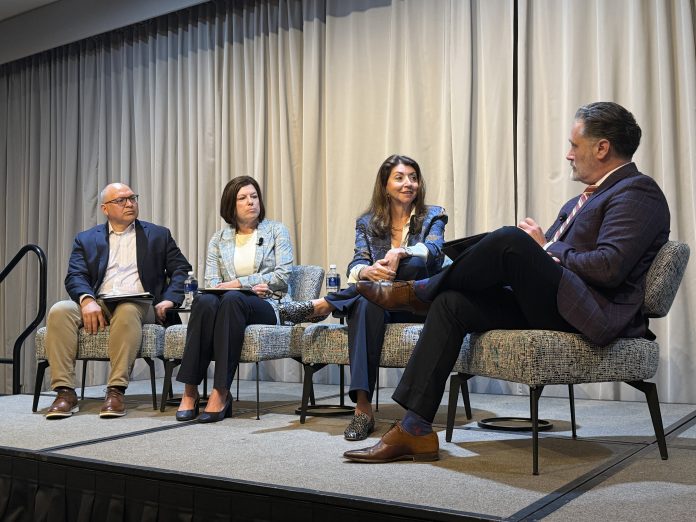
On Tuesday, Chamber President Zach Brandon led a discussion with panelists Lisa Barton, president and CEO of Alliant Energy Corp., Wendy Perkins, president and CEO of Wisconsin Physicians Service Insurance Corp. and Pablo Sanchez, first vice president of community engagement at Park Bank.
When asked about what the old Advocacy Agenda was able to accomplish, Barton said it really laid the groundwork for making Madison a place that people want to be.
Sanchez said he “thinks of the connections” Park Bank has made, and “the Chamber being able to support so many other businesses here in our community that rely on the Chamber’s leadership.”
That was true during COVID-19, especially he said, and Sanchez said the Chamber’s ability to work with other chambers in the area is a boon.
But a lot has changed since 2023, with the advent of AI, data centers and more.
“I think the biggest change for the energy sector at large has been the reshoring of a lot of manufacturing as well as data centers, AI, technology platforms,” Barton said.
Storing that data takes investments in energy, and Barton has seen an enormous investment in renewable energy like wind, solar and batteries.
She has seen traditional agricultural states, like Iowa, of which Alliant also services, turn into sites for technology businesses.
As for changes in health care, Perkins said costs are increasing “astronomically.”
“And especially on the drug side,” Perkins said. “As we’re able to figure out how to cure more things and keep people living longer, it just really comes at a cost. And we are seeing that over the last couple of years that the cost increases are just outrageous, quite honestly.”
Her other big change and concern is the access to health care. She said there is a need to focus on the right provider networks, which also comes at a cost.
“And so how do we use technology to help, looking at virtual health options and telehealth options,” Perkins said. “And then AI is certainly coming more and more into the health insurance industry, not only to make us more efficient in terms of claims process and call centers … but also from a broad risk of use perspective and trying to be smarter than those that are trying to game the system. There’s a huge amount of fraud within health care.”
Sanchez said for his banking perspective, a lot of things are just on hold. People are unsure of inflation, tariffs and general economic uncertainty.
“It makes it very difficult to go ahead and plan for the future when you’re in a situation like that,” Sanchez said.
“There’s never any one answer; there’s no silver bullet to any of this,” Barton said.
From a city standpoint, Barton said it mirrors Alliant’s business in that you need to solve for affordability.
“It can’t be too expensive to live here or people won’t be able to afford it,” Barton said.
This includes housing and childcare affordability solutions to attract talent to the Madison area.
Brandon added that it means the city needs to grow smart and grow up.
“Both maturing as a community but also physically growing up,” Brandon said. “How do we create density?”
That might mean building up to create density, and Brandon said the vision for the Advocacy Agenda also urges welcoming technology instead of halting it with moratoriums or an attitude of being resilient to change.
Barton told a story about living in Columbus, Ohio, and how the city and community checked off a myriad of needs to get an Intel facility to locate there. If Madison is overly restricted, or Columbus in this case, Intel doesn’t move to the area.
“We have to be a ‘say yes’ community,” Barton said. “We have to be open. Whether it be technology, construction, these companies have choices in where to go, and if we’re overly restricting in one way or another, then they’re going to choose to go someplace else.”
Perkins said this Advocacy Agenda brings Madison one step deeper into the important issues this time.
“We’re leaning in harder with this one,” Perkins said. “Some of the topics are the same, but I think some of the objectives … We’re trying to deal with what’s the root cause, what’s the real challenge.”
For example, she said leaning into AI is important with how much it is reshaping the world. It’s so important that the University of Wisconsin-Madison launched a new college focused on it.
With so much change, holding still with the status quo is a risk.
“It is so important to be open for business,” Barton said. She said Madison needs to have “a willingness to entertain conversations and that willingness to explore.
And to maintain business diversity.
“Having that diversity … we need to keep building that diversity and that becomes our secret sauce.”

