
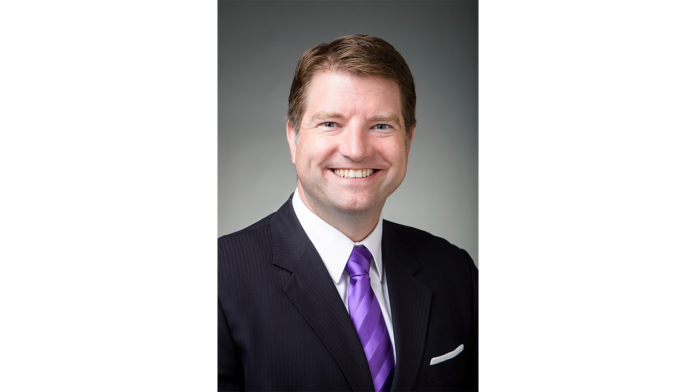

In his role as managing director of University Research Park, Aaron Olver champions the young companies at the forefront of scientific discovery.
Now, Olver is relying on stem cell technology to help him beat leukemia, and he still has big plans for both himself and for the research park.
As In Business Madison reported in early October, Olver is taking medical leave to undergo a stem cell transplant to treat the disease, a cancer of the blood and bone marrow.
He is in good spirits and determined, both about his eventual recovery and his optimism about the future of technology transfer from “gown to town.” This is why University Research Park, which supports early-stage, growth-oriented businesses spun out of University of Wisconsin-Madison research, was founded in 1984.
URP is also working to add housing and amenities to the business park, creating a neighborhood feel to the area.
Olver, who previously served as Wisconsin’s secretary of commerce and the city of Madison’s director of economic development, spoke with In Business Madison about the latest developments at URP.
For more than a decade, URP has been transitioning from the suburban-style business park to more of a dynamic model, and you’ve cited URP’s Element Collective housing development as an example of this. What else is on the horizon that will illustrate that dynamism?
When I think about how you drive the development of an innovation district, I think about a couple things. The first is the geometric arrangement of buildings, moving from a suburban model with big front yards and surface parking lots to pulling buildings up to the street and giving them a pedestrian orientation. So, we started that with the Exact Sciences headquarters, now Abbott, continued that with Element Labs and now of course the Mandel (property management) team has the Element Collective apartment project under construction.
In the course of setting those three projects in motion, we also built three new streets to start to carve some of the suburban super blocks up into a finer grain, more urban pattern so that we had a better palette. That created two more development sites that don’t yet have projects on them. So, the first thing is getting the basic geometry and arrangement of buildings right.
The second thing is we’re trying to create more magnetic places. So, we’re thinking a lot about the streetscapes, benches and the planters. If you go out and you look at the sidewalk near Abbott or the Element Labs, or outside the new apartment buildings, they’re not only distinctively different from the rest of the research park, but they’re also different from most places in Madison. You’d have to go downtown to find that kind of attention to placemaking and have a fine grained pedestrian bike infrastructure. So the second thing is to improve the connective tissue of the park.
Then the third thing is thinking about the mix of users there. We’re tremendously excited that we have our first apartment project under construction. We think that there’s sort of an obvious site next to that for another construction project, kind of a Phase 2 apartment project, and of course there are other sites in the park that are probably suitable for multifamily residential as well.
We’re also on the hunt for a restaurant operator. We built a purpose-built space in Element Labs, and we’ve been trying to curate the right partner. We’ve had a couple of flirtations, no marriages yet, so we’re looking to bring in some kind of food or beverage opportunity. I think of it as kind of a watering hole for the park. It could be a coffee-oriented watering hole. It could be more of an afterwork drinks kind of watering hole, but a place to gather in the park. Somewhere you might grab lunch or a drink after work, or somewhere you might have a breakfast meeting or bring your laptop and have coffee at work or grab lunch. And so, we’re trying to curate that.
If any of your readers are restaurateurs or entrepreneurs or are looking for sites to expand, we’d love to talk to people. We’re looking for something that can be both successful in the park and an amenity for the park, but also that will be a front door to invite the neighborhood and the rest of Madison to the park.
Were you able to do this dynamic approach from the start for University Research Park 2?
I would say that our strategy is a little different at URP 2, which divides naturally into two chunks. There’s a northern chunk and a southern chunk, and we think that the northern chunk might be a good place to pursue a similar strategy, a similar innovation district strategy.
We think the southern chunk wants to be inherently suburban, and that’s actually the site that we’re working on now, to uncork over the next year or so. The strategy is as we organize and densify the current park and try to create more of an innovation district model in our existing park, we recognize that there are users who need a big format, often single- or two-story buildings that are a little longer and have an inherently more suburban feeling. We want to have a product for those folks too.
Good examples of that would be Arrowhead Pharmaceuticals going out to Verona to build a manufacturing facility for the drugs they’re putting through trial, and Fujifilm buying the John Deere headquarters, or call center, and kind of re-kitting that out to be a lab — a biomanufacturing facility.
What excites you most about that Element Collective project? This gives you a chance to be part of the housing solution, not only for people employed in the park but for Madison in general.
We’re always kind of trying to hit three goals simultaneously. One, we want to try to serve our tenants — the people who are working in the park and who are here every day trying to advance science and push things forward. There’s no doubt that housing and the affordability of housing is a big issue for a lot of people. Plus, we think that having this mixed-use environment — also making it dynamic — is good for innovation.
Two, we’re trying to be a good citizen, so we’re right on a BRT (bus rapid transit) line. And so, this project kind of gave us a chance to upgrade our stormwater from a 10-year standard to a 200-year standard. It’s giving us a chance to be part of the housing solution by opening up a neighborhood in Madison, in the research park, that had never had housing, and to be in a place where we can consider housing. We’re trying to promote density and sustainable development — compact and walkable development as an antidote to just continually forcing people to spend more and more time on the Beltline by sprawling further away from the city core.
And then the third thing is we want to be good stewards of the land and the buildings that we have. We want to make sure the park stays fresh, that it’s attractive, and as Madison grows and this location feels increasingly central, we also feel a responsibility to weave it more into the fabric of the city.
URP is the home of Abingdon Health, which recently expanded in the park. Other than demonstrating that tenants can grow in the park, what does this expansion signify to you because Abingdon Health is a UK-based company?
One of the things we’re interested in right now is trying to put similar companies into a community. When I think about Abingdon Health, they are a lateral flow company. They’re making diagnostic products. We have other lateral flow companies in the park.
Of course, Abbott is there now. We’re talking to a new potential diagnostic startup, but we think that part of the magic that the research park can help with is curating a collection of companies that are in similar fields and by putting them into the same community, good things are going to happen over time.
What role does the park play in the growth of a company such as Exact Sciences, which has been acquired by Abbott?
I’m tremendously proud of our role in the Exact Sciences story, although of course it’s small. I don’t in any way want to take credit. It’s an amazing story from start to end and it’s been great for our community. I’m a huge fan and have known (former CEO) Kevin Conroy for a long time and the executive team there.
When they needed to build a new corporate headquarters, it was at a time when Exact Sciences didn’t have revenue. It wasn’t clear that they were going to become the juggernaut that they are today. What they really needed was a partner that was willing to step up and put their own credit on the line, and the research park had enough confidence in the company, in the science, in the trajectory, in the asset, and in the underlying real estate to do that.
So, we got a very difficult project financed in a way that was helpful to Exact Sciences and gave them this new headquarters building, which was important because they wanted the science team and the executive team to be in the same building. And so, we bought the lab building where their science team was and we built the headquarters building where the executives live. And then we connected them with an amenity-rich building with meeting space and food service and a gym.
In doing that project, we also set up future opportunities for growth on what they call the Innovation Campus (in URP). So, there are two buildings there now, but there are three development sites there. So, when Abbott is ready, the research park and Exact Sciences have done the work to kind of tee up three more pads where they could keep growing on that campus if they choose.