

Ironically, for Tom Eggert, running an organization that provides microloans has not been all about the money. That’s where the programs through his Madison-based nonprofit start, but WorldWise Microfinance is working to rewrite the script on microlenders.
The nonprofit has spent its 15 years in operation leveraging global connections to support entrepreneurs in countries with high rates of poverty and other obstacles. Its sustainable programs have spurred growth — economically and otherwise — in communities across multiple continents.
WorldWise Microfinance’s newest partnership with Ugandan nonprofit Nsimbi Impact shows that its dual goal of bolstering entrepreneurs — particularly women founders — and improving communities’ quality of life is doable when generosity and mutual accountability unite.
A call for aid
A 2010 natural disaster was the spark that Eggert said led to his interest in microloans. He was teaching sustainability classes at the University of Wisconsin-Madison and had a student from Haiti when an earthquake devastated Port-au-Prince and many surrounding areas.
Eggert said he and his students felt a “sense of responsibility” to render help to a country that was so close to their own, and they raised $3,000 from friends and family toward the effort. He recalled, however, that while many aid organizations provided food, shelter, water and medicine, another problem remained largely unaddressed.
“There were over 300,000 people killed, and then millions of dollars worth of property damage,” said Eggert. “Many people had no jobs to go to. Either the buildings that they worked in didn’t exist any longer, or the people that they worked for were killed, and so our goal was really just, how do we help these people that are looking to get themselves back on their feet?
“We couldn’t find an organization. I mean, everybody was very keen on cleaning up the mess … but that next step (was), how do you help a society recover?”
Eggert’s Haitian student introduced him to his former pastor, who had started an economic development group and suggested microloans as a potential solution to support entrepreneurs — especially women — in the midst of disaster. So began a consistent practice at WorldWise Microfinance: using personal connections to gain insights about communities in need, which offered an avenue to provide monetary support for residents.
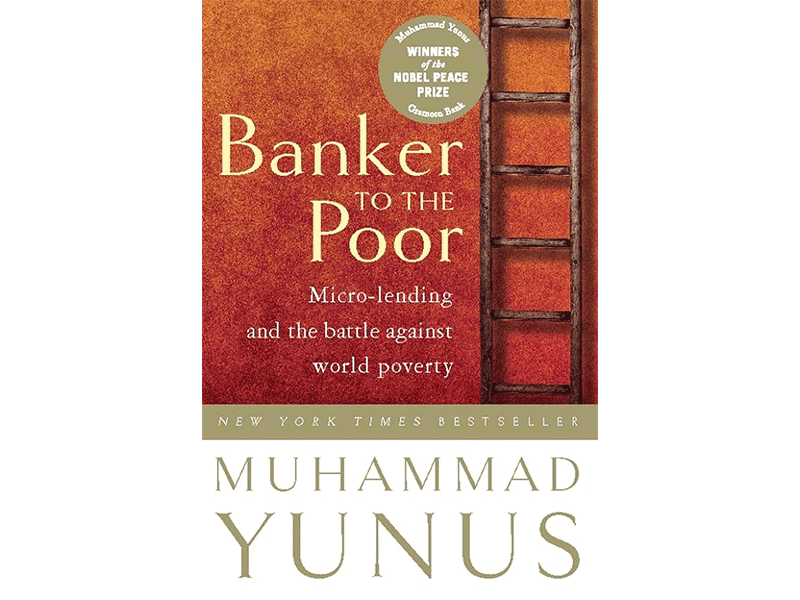
Another key influence came from a book, “Banker to the Poor,” written by 2006 Nobel Peace Prize winner Muhammad Yunus. Yunus asserted that repayment rates for microloans with no collateral would be higher than repayment rates for banks that make typical business loans.
“In fact, that turned out to be the case,” Eggert said. “We ended up choosing one (Haitian) community, sent them that $3,000, made about 60 first-round loans of about $50 each — they were six-month loans with 1% interest per month — and they all got paid back.”
The program not only executed its intended purpose to catalyze women’s entrepreneurship, but also saw unanticipated, more widespread economic effects.
“The loan program had led to a lot of government investment in the community,” said Eggert. “There was a health clinic that was built. There was a school that was built. Introducing this idea of this loan program to help small businesses seemed to generate interest from the government in providing additional infrastructure to the community.”
Replicating success
The experience in Haiti generated momentum that prompted a broader vision for the microlending program.
“We were quite happy focusing on Haiti,” said Eggert. “We had great stories to tell. But in 2014, we were approached by a group of returned Peace Corp volunteers … that said, ‘You did this great thing in Haiti, and it’s continuing to make a difference. There was just this typhoon that went through the central part of the Philippines that was just as devastating as this earthquake. Would you ever consider doing a program in the Philippines?’”
Eggert’s answer was a resounding ‘yes,’ but with one caveat: The group would have to conduct its own fundraising.
“We had a website, we had the infrastructure, we just didn’t have any money,” he said.
As the group pursued raising its own money, programming expanded to the Philippines in 2014, followed by the Dominican Republic during the COVID-19 pandemic, and Ghana and Kenya by 2024. Each foray into a new country was initiated through a personal connection with a specific community, allowing WorldWide Microfinance to forge a global network while programs were managed at the local level.
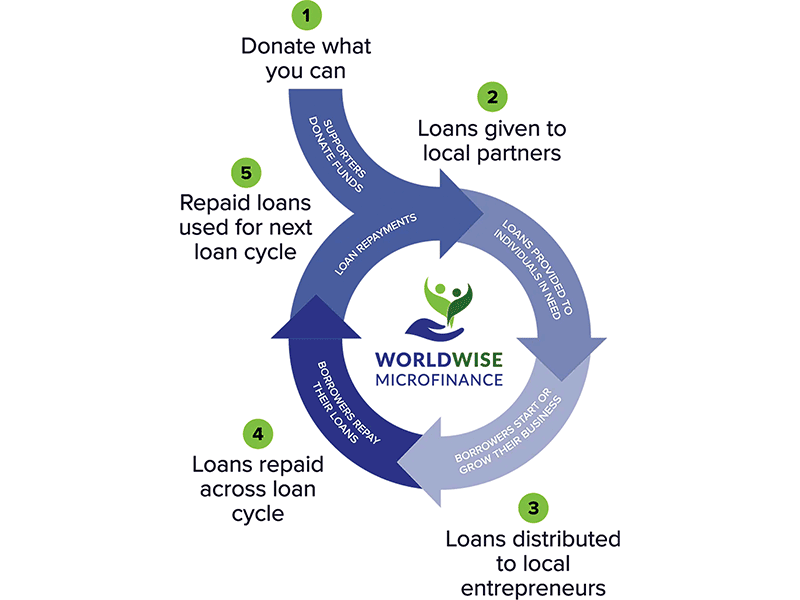
Donations to the organization ultimately allowed it to establish a revolving loan fund, and as the nonprofit’s reach grew, Eggert worked to establish organizational standards and practices.
For instance, WorldWise Microfinance stipulates in its memorandum of agreement with each partner that interest rates on microloans must not exceed 1%, and partners must report on both the principal repaid and interest repaid by loan recipients each month. The interest on loans covers the costs groups in each country incur to administer the program.
“We’re not sending money into the countries to employ people,” said Eggert. “We’re trying to find organizations that are already committed to helping the poor — ideally helping women within the poor community — to get financial access to the banking system … and to others that are helping them take steps that help their family escape from poverty.”
Partner agreements also require that 80% of the microloans must be distributed to women.
“There are some great academic studies out there that show how important it is to get women money — that women, when they get money, they use it to improve the lives of their families,” said Eggert. “That’s not always the case if men get money, so our target has been women … in addition to the fact that it’s the right thing to do.”
A natural collaboration
April marked the launch of WorldWise Microfinance’s most recent partnership with Ugandan nonprofit Nsimbi Impact, headed by founder and CEO Barbara Mutabazi.
Mutabazi’s background in information technology and artificial intelligence, in combination with an MBA from the MIT Sloan School of Management, helped inform the goal of her organization, which is to expand financial inclusion for women seeking to start a business.
“Nsimbi Impact was born out of both my lived experience working with women entrepreneurs across sub-Saharan Africa and the rigorous study I undertook at MIT. After years of witnessing firsthand the systemic barriers women face in accessing capital, especially those in rural or informal settings, I set out to design a solution that is both inclusive and scalable.
“Our model combines technology, financial literacy and mentorship to ensure that women not only gain access to capital, but also have the tools and support they need to build thriving, sustainable businesses.”
She called the partnership with WorldWise Microfinance a “natural fit,” with a common focus on underserved populations and “deep roots in local communities.”
While the program is still in its early stages, women have already received microloans between $100 and $200, and Mutabazi said they are “already seeing promising outcomes.
“These small but catalytic amounts have gone a long way in helping women strengthen and grow their businesses,” she said. “One example is a young woman in Mbarara who runs a small poultry business. With a $150 loan, she was able to buy higher-quality feed and increase her stock. Within just a few weeks, she reported increased egg production, better sales and enough income to hire part-time help from her village.
“Another entrepreneur in Kampala used a $200 loan to restock her grocery kiosk. She sees a significant increase in daily transactions and has begun saving for her children’s school needs, something she previously struggled to do consistently.”
Mutabazi said Nsimbi Impact “also supported a woman running a small scale tailoring and mending business. With a $100 loan, she purchased fabric and materials in bulk, allowing her to take on more customer orders and grow her income.”
For Mutabazi, these stories exemplify how pairing modest amounts of capital with trust, mentorship and financial education can have a transformative effect on people’s lives.
Providing what she calls “affordable, dignified capital” to women who may lack collateral or literacy skills, or have a limited credit history, is critical to overcoming the barriers that have prevented them from receiving formal financing in the past.
“Beyond the financial support, we are seeing a profound psychological and social impact,” she said. “Women report feeling more confident, independent and empowered to make decisions not just in their businesses, but also in their homes. Many have increased their income, reinvested in their enterprises and even created jobs within their communities.
“We’re also equipping these women with financial literacy and business skills. … This ongoing support ensures that capital alone isn’t the only resource they receive, they’re gaining the knowledge to manage and grow their businesses sustainably.”
Community support
WorldWise Microfinance takes inspiration from Yunus, the Nobel Peace Prize winner, in another way, and Eggert said, it’s “the biggest thing that makes our program work.”
“Every loan recipient is part of a peer group of six or eight people,” he said, “and no one in the group can take out a second loan until everyone in the group has paid back their first loan.”
He said that if a loan recipient ends up with a health issue, or has a bad business idea, or are unable to pay back their loan, they get support from others in the group who want to take out another loan.
It works as a sort of insurance that loans are paid back, and it has been a successful approach.
“In 2023 and 2024, we had a 100% repayment rate across the countries that we were in, and it really is a tribute to the power of this model, that individuals in a community can hold each other accountable — either nicely in a peer support kind of model, or not so nicely in a peer pressure kind of model.
“The idea is the same: My future success is tied to you doing what you’re supposed to be doing, so I’m going to make sure that you are successful — at least successful at paying back the loan.”
Eggert noted that there’s one final practice that distinguishes WorldWise Microfinance from other microlenders — and it has as much to do with ethics as economics.
Before loans are made, residents must complete a quality of life survey. Questions center on whether or not they own a home, their level of access to certain resources, the number of days their children attend school, their health outcomes, their number of weekly meals and the nutritional quality of those meals.
“What we’re trying to do is respond to the criticism that is out there of microfinance,” said Eggert, “that loan recipients, we put them on this hampster wheel: They take out a loan, they work hard and they pay back that loan, and they take out another loan and they work hard, but they’re no better off.
“We want to show that people are actually better off in ways that maybe aren’t obvious.”
The data so far support his claim.
“We’ve documented that people are eating more meals on a weekly basis. More of those meals have a source of protein. Their kids are in school more. Their health outcomes are better. “We can show that these small loans are … making a difference in measurable ways.”

