
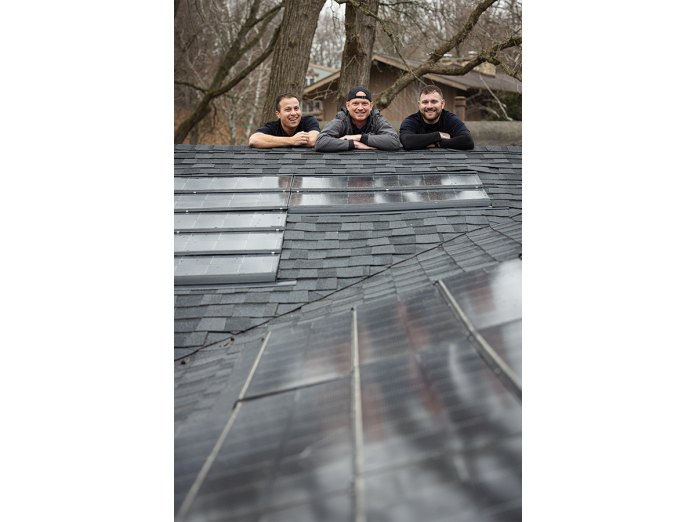

Jon Torre and his business partners are reinventing the roof.
Sun Vault Roofing, a company Torre co-founded in January 2025 with Kyle Mumm and Mike Mannion, is a “pro-solar” roofing company that offers products that — in addition to protecting Wisconsin homes — are adding renewable energy to the grid, with options that are more sustainable and economical in the long term.
The Madison business is two-sided: Sun Vault is both a solar and a roofing company, and that dual focus — along with an innovative solar shingle technology — has propelled the startup to more than $1 million in revenue.
“Traditionally, roofing and solar haven’t collaborated well as industries,” said Torre. “The skill sets are very different, and very few companies can actually do both well.
“We realized that we had this skill set that was lacking in the market, and that by bringing our complimentary areas of expertise together, we could start designing integrated roof and solar systems that maximize energy production for the most reliable, high-quality, durable roof possible.”
That’s a challenge in Wisconsin’s climate, where roofs must be able to hold up to harsh weather conditions, including heavy snow and ice, for much of the year. While the company is “pro-solar in all forms,” Torre said he and his partners knew they had to focus on products that first and foremost would protect people’s homes.
In addition to providing regular asphalt shingles and conventional rooftop solar panels, they offer a cutting-edge solar shingle product in partnership with Pennsylvania-based CertainTeed, a 120-year-old roofing and building supply manufacturer.
“This is one product that has two jobs, but we think that one job is a little bit more important,” said Torre. “Some other products that were developed by solar companies do a great job of producing energy, but they leak, or the install is too complicated, or a roofer doesn’t have the skill set necessary to put it up.”
Integrated solar shingles replace asphalt shingles and are built directly into the roof of a home. Like conventional solar panels, they aim to reduce energy costs by harnessing energy from the sun to offset home energy consumption.
They come at different price points and with varied installation techniques, Torre said, which can affect how much additional training is required for roofing crews to install them.
CertainTeed’s solar shingle, he said, is installed much like a regular asphalt shingle and requires minimal additional training for roofers. The added complexity comes with hooking up wiring and electrical for the product after installation, for which the company hires licensed electricians.
As a well-established company, CertainTeed was able to provide much-needed support to Torre’s fledgling enterprise.
“A solar company (can decide) to make a solar shingle — Tesla did that,” Torre said. “But a company like Tesla, we thought, probably wasn’t going to invest as much in someone like us because their product is already a little more popular elsewhere.
“CertainTeed was really getting theirs off the ground. … We’ve been really lucky (with) CertainTeed. We were their top installer of solar shingles last year … and because of that, they have invested quite a lot in us. They sponsored a lot of our marketing efforts and had done a lot of their own marketing in the area to funnel interested customers toward us.”
Zachary Easoz, the solar sales manager for CertainTeed’s east region, said in a statement that Sun Vault’s approach aligned with its own.
Sun Vault is “committed to delivering exceptional quality and providing reliable customer support from start to finish,” Easoz said. “That dedication to integrity, service and long-term customer satisfaction is exactly what we look for in a partner.”
Calling solar integrated roofing shingles “the next era of roofing,” Easoz said CertainTeed’s Solstice Shingle is “a true two-in-one system… saving on utility costs and offering greater energy independence. It’s a smarter way to turn unused roof space into meaningful long‑term value.”
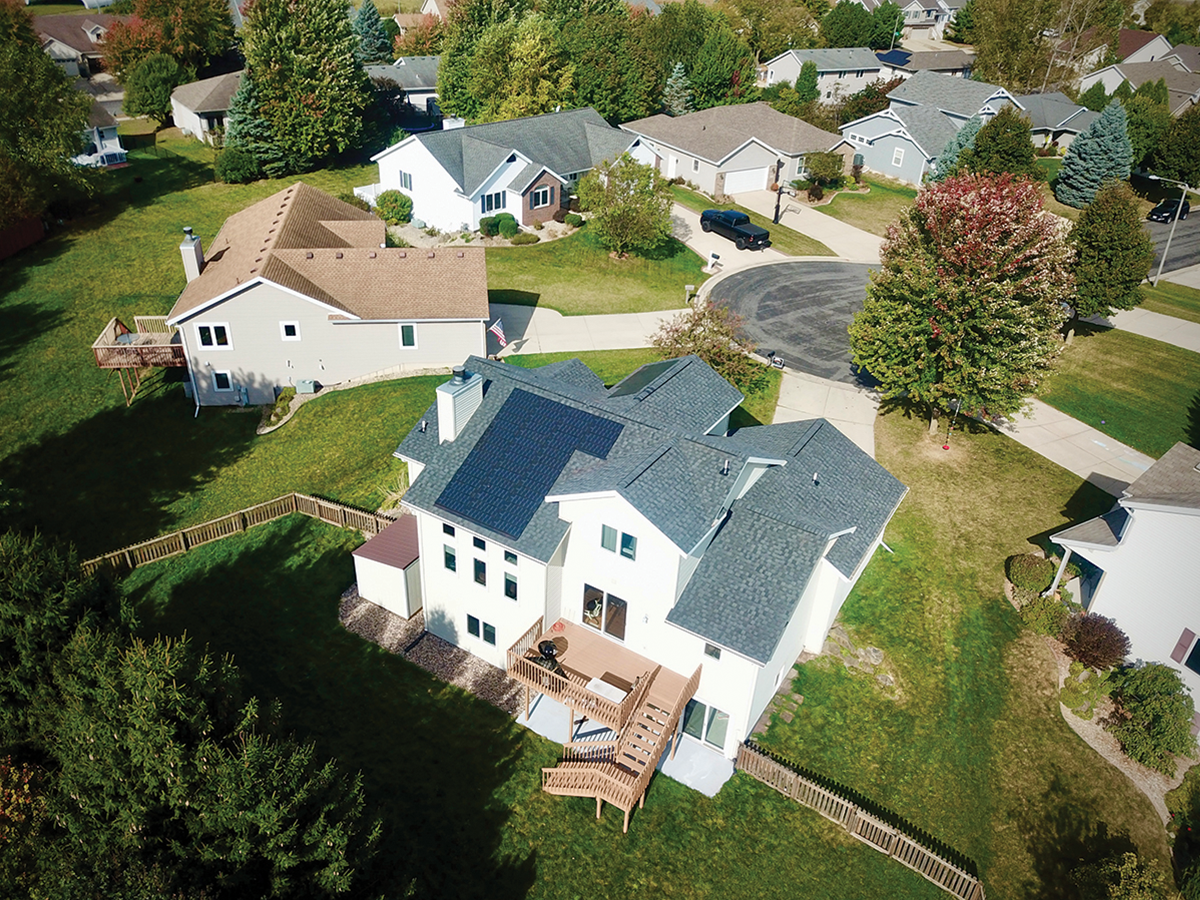
Torre said that while solar shingles carry higher upfront costs, they have several advantages over conventional rooftop solar panels. Because panels are slightly raised rather than flush with the roofline, rodents or other pests can nest underneath and may chew through wires or even the roof itself if they become trapped.
He noted the panels are also very heavy and are attached to the roof with steel racks and rails that must be drilled through the roof’s surface into the attic rafters. While those penetrations have a low individual likelihood of leaking, hundreds of penetrations make leaks more likely over the 30-year lifetime of a roof.
Conventional solar panels are also more prone to weather-related issues such as ice damming and wind damage, he added.
“Last year was the windiest spring Wisconsin has … seen (in decades),” said Torre. “Our product (alternative to conventional panels) is a shingle that’s also a solar cell. It’s not raised off the roof. There’s no space underneath for critters to crawl. They don’t cause ice dams and aren’t vulnerable to wind.”
They also have an aesthetic advantage.
“There’s always been this pocket of individuals who have been hesitant to adopt solar because of how it looks,” said Torre. “I don’t think it’s ugly — the conventional ones — but it is a bunch of hardware and infrastructure on your roof, and it’s visible.
“(With) our product, you can still tell it’s solar, but it’s a lot more seamlessly integrated with the roof. It’s lower profile, and it doesn’t stick out as much.”
While solar roofing is not the right fit for every home — depending on factors such as the household’s energy usage, the direction it faces, the amount of sunlight it receives and the location of roof obstructions like vents and pipes — Torre said it’s important to consider as Wisconsin transitions to renewable energy.
Last year, Sun Vault’s revenue came roughly 50% from asphalt roofing and 50% from solar options, totaling approximately $1.25 million. Torre hopes to double that number in 2026.
His preferred metric by which to measure the company, however, is the amount of solar in kilowatts the company has installed.
“It’s not just financial — it’s meaningful globally,” he said. “That was close to 80 (kilowatts), or 80,000 watts of solar, on rooftops, that was added to Wisconsin’s grid. … Each solar roof is designed, if it can, to offset that home’s energy consumption. So 80 kilowatts … is approximately offsetting the annual electricity use of eight or nine homes.”
The company’s other plans for the next year center on staffing and space. Sun Vault currently operates out of Synergy, a coworking space on Raymond Road, and purchases materials on a per-job basis. Torre said he and his co-founders are seeking a warehouse space so they can start buying and storing material in bulk.
Sun Vault’s three founders are also its only full-time employees and are aided by one part-time worker — the rest of the company’s labor is contracted — but by spring or early summer, Torre said he anticipates hiring two additional full-time employees and potentially upgrading their part-time employee to full-time as well.
Sun Vault Roofing snapshot:
▶ Industry: Roofing/solar
▶ Revenue: $1.25 million
▶ Staff size: 3 FTE, 1 PTE
▶ Year of origin: 2025
▶ Location/headquarters: Madison
▶ Number of customers: 100-150
▶ Revenue sources: Solar roofing, conventional roofing
▶ Business classification: LLC

