
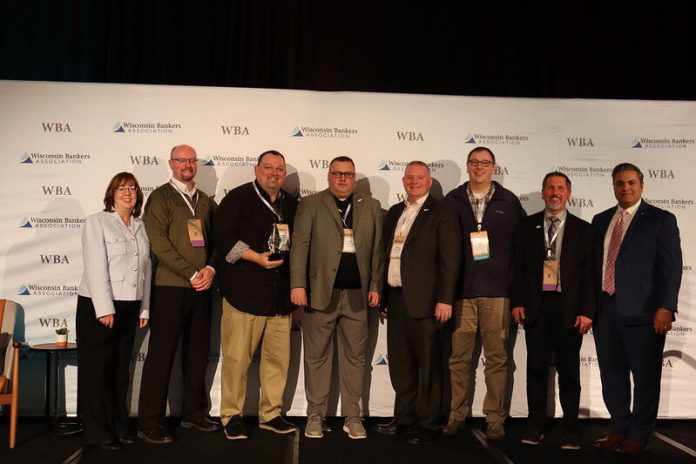
When the Wisconsin Bankers Foundation last month awarded Bank of Sun Prairie its Financial Education Innovation Award, recognizing a unique partnership between the bank and nonprofit Society of St. Vincent de Paul–Madison, Jimmy Kauffman, Bank of Sun Prairie’s president and CEO, had one thing to say: “It’s tremendously meaningful … but we’re not doing this to get awards, we’re doing this to make an impact on the community.”
The bank and nonprofit developed a collaborative program that provides microloans and financial literacy support to community members in need — particularly those who might otherwise be forced to turn to predatory lending services or are at increased risk for homelessness.
The initiative looks to provide a path to financial wellness, a means for individuals to retain their homes and manage their expenses, and be a model for other Wisconsin banks and charitable organizations.
Julie Bennett, CEO and executive director at Madison’s St. Vincent de Paul, assembled a task force of educators and banking industry experts in 2020 to get the program up and running. Stephanie Wallom, Bank of Sun Prairie’s VP–branch banking, was among those consulted and still works with the nonprofit.
Wallom said the task to create the program — particularly building an innovative service while ensuring fairness and compliance — was daunting, but “there was never a [thought of], ‘Oh, we shouldn’t do this. This is going to be too hard.’ … It was always, this is just the right thing to do.”
John Loeffler, the bank’s chief retail officer, said that as they were creating the program, they considered, “how can we have products and services that really work with … all demographics of the communities we serve?”
“Bank of Sun Prairie really raised their hand,” said Bennett.
Through the microlending program, community members can receive low-interest loans between $400–$2,500 for a one-time expense, repayable over 12–24 months. There are a few eligibility criteria — for instance, prospective borrowers must have a debt-to-income ratio no higher than 47%.
“There is a little wiggle room,” said Bennett. “If somebody has a predatory loan that, by virtue of getting a low-interest loan, would move them from [above] 47% to lower than that, we say yes.”
The bank also runs a credit check to rule out other variables like unknown outstanding loans and to see individuals’ credit scores — which Bennett said does not disqualify someone from getting a loan.
“The goal is to grow that credit score by being able to make a monthly payment as well as to help people become banked,” she said, adding, “We’re looking for ways to say yes, not no.”
She said establishing a banking relationship can be a “step out of poverty,” as living in a cash economy is expensive. Those who cash their paychecks at a cash store, she noted, can be charged as much as 20% of the total amount, and predatory practices like payday and title lending can exacerbate money issues or even contribute to homelessness.
The costs for people who struggle to make ends meet can be staggering.
“It gives me goosebumps to think about the individuals who have gone in and put their vehicle up for collateral so they can pay for rent or moving expenses, and they’re paying 400% interest over the course of two years,” Wallom said.
She said the program can help community members who are newcomers to the world of personal finance, as well.
“They very much want to have these financial discussions, but there might be an element of intimidation to come into the bank,” Wallom said. “It’s been so moving to be able to help people … who felt that maybe they never were going to be given a chance.”
The program also arms borrowers with fiancial literacy support. UW Extension trains St. Vincent de Paul–Madison volunteers who check in with loan recipients on a monthly basis to provide knowledge and resources applicable to borrowers’ circumstances. Bennett said in the future, financial educators may even lead group classes.
“We can provide information,” said Bennett. “This is why it’s really important to have insurance for your car, or why you want to keep a checking account and put a little money in a savings account, or this is how you check your credit score. …Those are all really important things.
“And,” she added, “not sufficient. Financial literacy has never … lifted someone out of poverty.”
In order for programs like these to be effective, they must make money accessible, they must provide viable alternatives to predatory loans, and they must spread.
“We do not run the only food pantry in town. We do not need to run the only microlending program in town,” Bennett said. “If there is another nonprofit, or 50 other nonprofits, who are willing to do this alongside us … we will teach them what we’re doing. This is an opportunity. … It is a very applicable model.”
Said Loeffler, “When you see how this impacts someone’s life, it’s life-changing for us.”

