

From the pages of In Business magazine.
Plenty has been written about kombucha [kom boo cha], an effervescent, fermented tea packed with vitamins and probiotics and brewed for thousands of years. First rooted in China — or Russia (there is some debate) — the drink’s surge in popularity, particularly in the U.S., is likely being driven by a population growing more interested in healthier living and an awareness of what humans are feeding their bodies.
When certified herbalists Vanessa Tortolano and Alla Tsypin launched NessAlla Kombucha 11 years ago in the basement of The Weary Traveler restaurant on Williamson Street, the company was one of the first craft kombucha brewers in the world. For the first few years, the business partners spent most of their time educating people on the benefits of “booch” while brewing 20 gallons a week.
These days, the company is producing 100 times that amount.
NessAlla’s operations continued to grow at its second location on Park Street, but with its lease ending and the opportunity to expand to the soon-to-be-completed Garver Feed Mill in January 2019, the co-owners decided to move the company forward in a huge way as Garver’s first tenant.
Surrounded by daily renovations coupled with a new apartment complex going up on Fair Oaks Avenue, this is still very much a construction zone. But in just a few months, the muddy acreage will transition to a hub of activity largely related to local food production, plus short-term rentals in the form of micro-lodges.
Inside the first brick building, NessAlla produces 2,000 gallons of craft kombucha each week and distributes it in 16-ounce bottles, 64-ounce growlers, or five-gallon kegs to retailers, restaurants, and bars throughout Wisconsin and in bordering states. Less than half of the product — about 40 percent — remains in Dane County.
Kombucha has been making headlines lately. In terms of the beverage marketplace, refrigerated kombucha is part of a category of fermented beverages that in 2017 surged 37.4 percent to $556 million, according to foodnavigator-USA.com. More recently, the owner of another Madison company struck a deal on ABC’s Shark Tank to bolster its home-brewing kit business.
Early beginnings
|
Making the effervescent drink starts by boiling Rishi teas and raw sugar in water. |
Tsypin and Tortolano met in herbal class and became fast friends. “Vanessa and I bootstrapped the company,” Tsypin says. “We had $50 and a credit card. In hindsight, business school may have helped, but it may have put us in a box, too. We had to think outside the box and go with our gut.”
Tsypin, whose family emigrated from Russia to the U.S. in 1978, was raised in Minnesota. Not only was she familiar with the fermented tea, she was brewing it at home as part of a personal commitment to a natural diet and herbal medicines.
Tortolano, a Hawaii native, musician, and stand-up comedian, was first introduced to kombucha while cashiering at Madison’s Willy Street Co-op years ago. “I saw a lot of it coming through the lane so I started drinking it and loved the taste and how it made me feel, so I started researching it,” she says.
There still is an ongoing debate as to how kombucha should be defined and legislated, so while they can’t make broad statements touting its health benefits, Tsypin and Tortolano can certainly speak from personal experience.
“It makes me energized and alert,” Tortolano reports, yet the amount of caffeine (equivalent to two sips of coffee) and alcohol is miniscule.
|
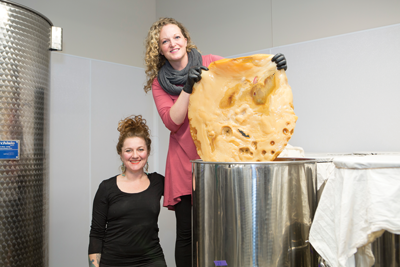
Vats are covered with cloths and sit for several days, allowing SCOBYs to grow naturally. |
Alcohol occurs naturally due to the fermentation process, with most kombucha sold on store shelves containing less than 0.5 percent ABV (alcohol by volume). For comparison sake, the average beer contains 4.0 to 7.0 ABV, and wine contains even higher amounts.
“It’s not an alcoholic drink,” Tortolano states, “and it’s not the caffeine that makes me feel healthier.” Rather, she suggests, it’s kombucha’s ability to oxygenate the blood and brain that creates a more sustainable effect.
Tsypin was plagued for years with stomach issues and credits the probiotic elements of kombucha with making a huge improvement in her gut health.
We visited the local company recently to learn what kombucha is, how it’s made, and learn about the living organism that makes fermentation possible.
(Continued)
Brewing booch
Bakers may be familiar with Amish Friendship Bread, where portions of starter doughs are passed to family members and friends to create more and more breads.
|
Tortolano pours a feeder mix into a new batch of booch. |
Kombucha is similar from that respect, but its starter is the SCOBY, an acronym for Symbiotic Culture Of Bacteria and Yeast. It’s a thick, gelatinous mass that forms on the top of each new batch of kombucha to host the yeast and bacteria needed for fermentation.
It’s not pretty, but the SCOBY does much of the work. “You really get attached in an odd way,” Tsypin admits, because it’s a naturally occurring, living organism.
The company’s 16,000-square-foot space provides plenty of room for growth. Stainless steel is the rule here, and large 55- and 200-gallon vats on wheels are numerous. There’s a brewing area, a bottling and kegging area, a large storage warehouse with two loading docks, and an enormous room-sized cooler kept at 38 degrees.
On brewing days, NessAlla’s bottling operation can fill about six 16-ounce bottles every 11 seconds, and staffers add stickers and “Best By” dates before placing the product on pallets. The kombucha then sits in the cooler for about a month.
“When our kombucha is really fresh, it’s not always hitting all the right flavor notes we’d like it to,” Tortolano explains. “After a month in the cooler, it’s perfect.” The product has a shelf life of about six months.
The operation is both sustainable and energy efficient. NessAlla purchases 100 percent green power from Madison Gas & Electric, and heat generated by its cooler is reclaimed and pre-heats much of the business’ hot water system. Also, the company’s unused or discarded SCOBY is donated to Robert Pierce, a local urban farmer teaching formerly incarcerated individuals about agriculture and growing food. Evidently, composted SCOBY can be a great fertilizer.
|
Bottling occurs twice a week. Staff affix labels and “Best by” dates before the product is boxed and moved to the cooler for a month. |
Kombucha competition is increasing worldwide. “I think it’s cool because it solidifies kombucha’s standing,” Tortolano says, “but some of those new companies have investors and resources we don’t have and have chosen not to have. We’re creating very high-quality, premium kombucha, whereas not all companies are equal in that regard.”
One reason, they explain, is that government regulators have yet to describe exactly what kombucha is.
Bourbon, for example, must contain at least 51 percent corn and be aged in new charred oak barrels.
Kombucha has no official definition, which causes some angst.
“Some companies use carbonated flavored water, add a capful of kombucha tea, and call it kombucha,” Tsypin laments, so the public doesn’t know what they’re drinking. The industry is working on it, she insists, reminding that the craft kombucha industry is only about 10 years old and therefore still in its infancy.
While that issue gets debated, Tortolano and Tsypin can hardly contain their excitement as spring and summer nears and the rest of the Garver tenants move in.
One ongoing challenge they don’t look forward to, however: “Fruit flies,” Tsypin states. “Fruit flies adore fermentation!”
Click here to sign up for the free IB ezine — your twice-weekly resource for local business news, analysis, voices, and the names you need to know. If you are not already a subscriber to In Business magazine, be sure to sign up for our monthly print edition here.

