

Growing up in Uganda, Rogers Senteza said he always had a love for woodworking, carpentry and for working with his hands, but there were not many opportunities to pursue this dream before he came to the United States.
“Maybe we don’t have enough institutions that teach these skills (in Uganda),” he said, speaking at a ribbon cutting for Madison College’s new Construction & Remodeling Facility at Truax on Nov. 19.
“And the buildings and structures that we put up … are built mainly from brick and mortar and concrete.”
Senteza said his desire for hands-on work, coupled with a love of numbers, is what drove him to enroll in the college’s Construction & Remodeling program, from which he recently graduated.
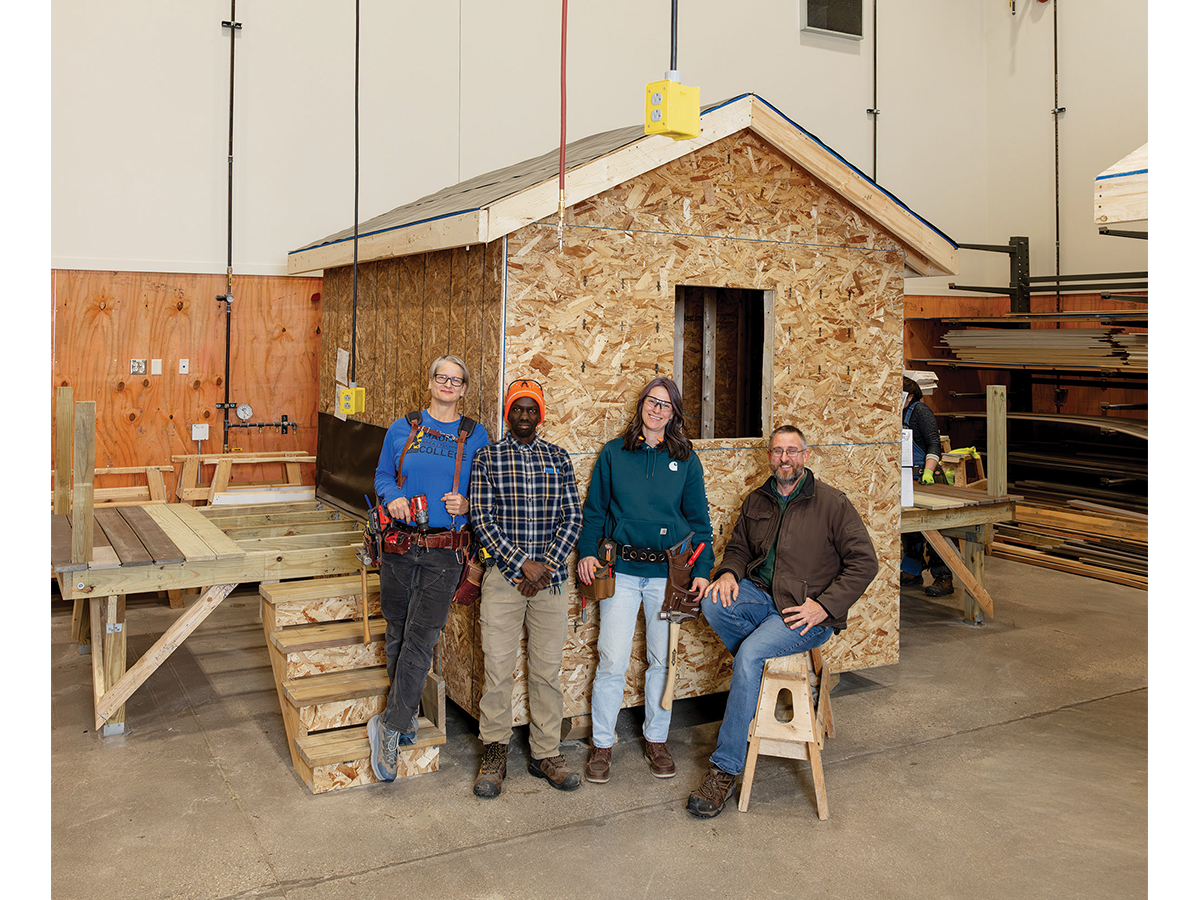
Senteza is not alone. Enrollment in the C&R program has increased 26% from its pandemic-era low in 2021, and with the addition of the new facility, Madison College will expand its course offerings. Plans are also in the works to grow its workforce partnerships, like its collaboration with Tony Trapp Remodeling, which employs five C&R graduates — four of whom are women making a dent in a field where they are largely underrepresented.
As demand increases for construction workers, the state-of-the-art building and expanded programming on Madison College’s Truax campus are set to create new opportunities for students to gain hands-on experience, connect with area employers and fill a gap in the local workforce.
“During the 2008-2009 recession … people left the industry,” said Tony Trapp, founder of west side Madison’s Tony Trapp Remodeling. “It went on so long that it was never backfilled, so that need for skilled people has gotten more urgent, especially as more folks are aging out.
“Having a program like the Construction & Remodeling program in the Madison area is phenomenal. The instructors are recruiting folks that are from diverse backgrounds. That’s helped us as well. (People are) saying, ‘I can’t get guys.’ Well, there’s a whole other segment of the population you’re ignoring, and we need to make a better workplace to attract and retain those people.”
New home to build new homes
Trapp said students emerge from the Madison College program “very prepared” for the realities of the jobsite, with a solid foundation of skills to build upon when they graduate and enter the workforce.
When Senteza was a student, the C&R program helped him secure part-time work with Tony Trapp Remodeling, which has now led to a full-time role with the company.
“It wasn’t easy, but it was exciting,” Senteza said, adding that everything “just lined up perfectly.”
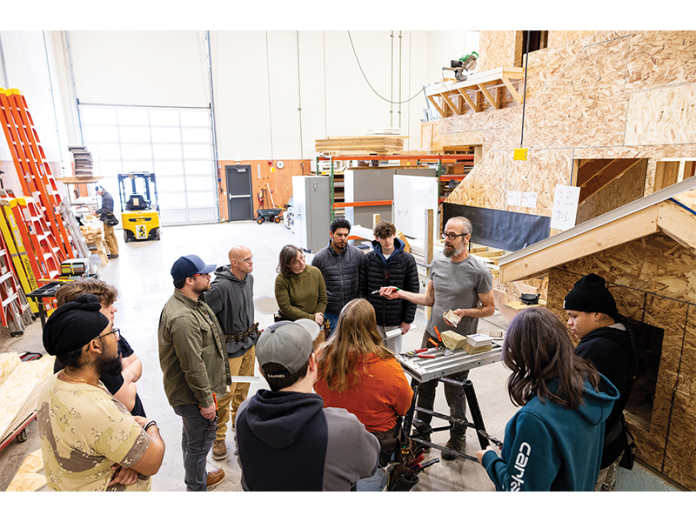
Senteza was among the first students to experience the C&R program in its new home, which he said offers more opportunities for students to collaborate and build important skills.
“The program … is making us employable,” he said.
The new $10.3 million, 30,000-square-foot facility relocated the C&R program from its Commercial Avenue campus to its new home at 1849 Wright St. beginning with the fall 2025 semester. The move also increased participants’ access to advising, financial aid and other campus services while expanding the space, tools and other resources for building instruction.
Designed by Strang architects and built by Daniels Construction, the new facility offers a lab for power tool and safety education; a computer lab; two classrooms; two workshops equipped for roof framing, siding, insulation and green building demonstrations; and areas for student collaboration.
Sandra Thistle, a C&R program instructor who is nearing retirement after 31 years with Madison College, said the shared spaces for students create an opportunity they never had before.
“We never had room to be a community in the old space,” she said. Now, “we have this beautiful student lounge, and all these booths, and the students use them. They stay here, they hang out together. … It’s way more than just class.”
The indoor learning setting is conducive to student construction of sheds, garages and tiny homes — activities that previously had to be completed outdoors.
It also includes sustainable building features like a 125-kilowatt rooftop solar array, light control systems, water-saving fixtures, advanced heat recovery systems, a rainwater bioretention basin and electric vehicle charging stations.
Programming with broad appeal
John Stephany, director of the C&R program, said the new facility has helped draw more students from a variety of backgrounds, and that graduates are helping to meet a range of local needs.
“People started learning about (the program) because they saw the tiny homes we were building,” he said, adding that the structures students build are often sold to local partners to provide area housing.
“We’ve worked with the city (of Madison). We’ve worked with private buyers. We’ve had no trouble — tiny homes are taking off … and they’re the perfect project for our students. … It’s a win-win-win.”
Students in the C&R program have ample opportunities to apply their learning, working in small groups of three to five, Stephany said, and when they graduate, “They can go to work for just about any contractor … and walk on the jobsite and know what they’re doing.
“And almost all of our students stay local.”
He also said the program can now better prepare students for work with area employers seeking to fill out and diversify their workforce — a move C&R instructor Thistle argues is an asset to the school and the industry.
“People need to see other people who look like them in the industry and as their mentors and teachers,” she said. “And even though when you have more voices, it’s more work, the end result is always better.”
She also noted that the C&R program could help reshape how people think about the trades.
“How people think about construction is so narrow… and that minimizes so much other skill that’s brought to this arena: big brains, problem-solving, creative thinking skills … ability to communicate.
“I really feel that the industry in Madison does get (the need for diversity), way more than ever.”
Both Stephany and Thistle said they love to see more women and students of diverse racial and ethnic backgrounds joining the program in the expanded space.
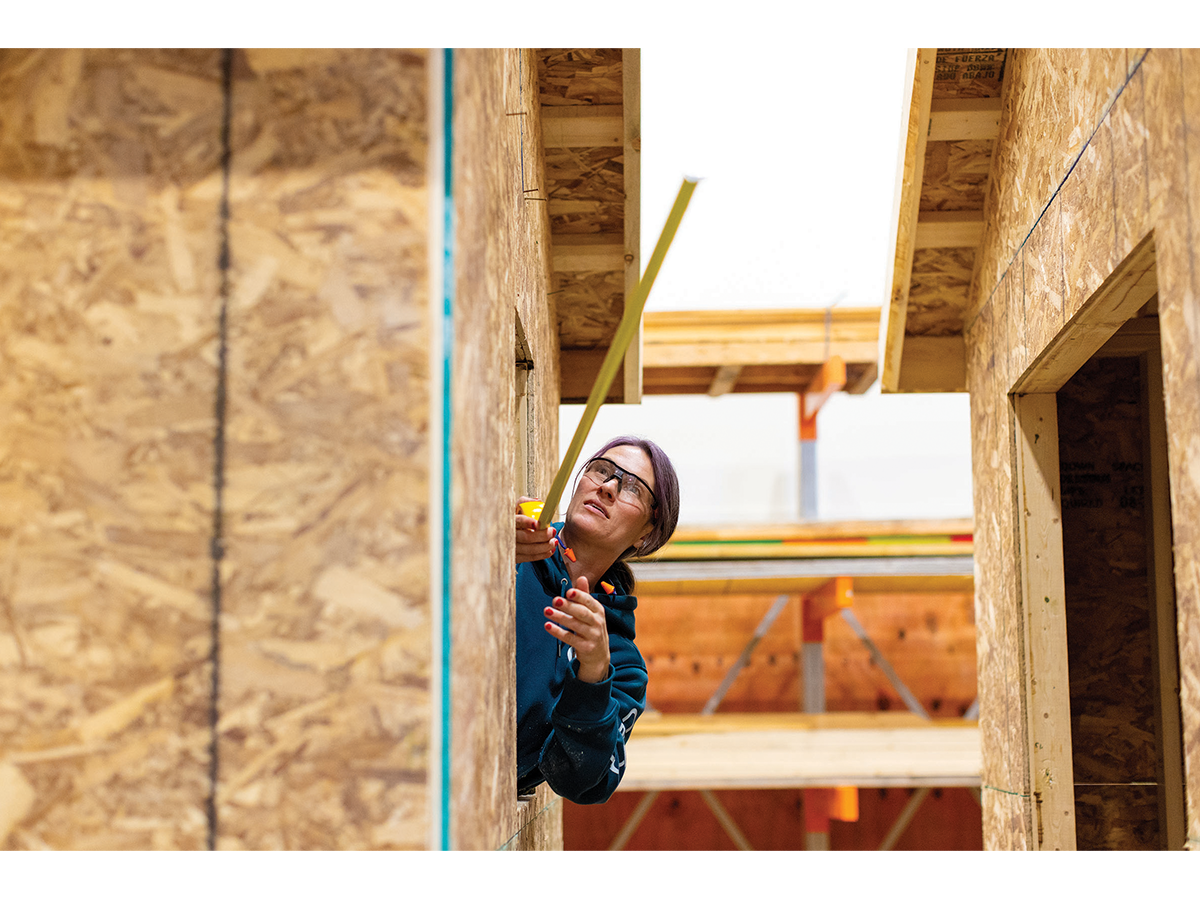
Stephani Dalbesio is enrolled in the Introduction to Construction course, which focuses mainly on framing. She is a part-time student who plans to complete the program over two years, and is one of the 55-75 students that the C&R program serves annually.
Dalbesio — who in partnership with restaurateur Tim Thompson owns The Library Café & Bar near the University of Wisconsin-Madison and The Free House Pub in Middleton, among other restaurants — was looking for new inspiration in her professional life.
“The restaurant industry is very volatile right now, and I have done it for 22 years, and to be very honest, in a post-COVID world, we’ve kind of been muddling through it for the past five years, and I’m burning out,” she said.
“I’ve got a 4-year-old kid, and … I don’t understand (that industry) any more, and I just don’t have the time, passion and drive to relearn my whole industry, (which is) kind of what it feels like I’d need to do.”
Dalbesio said managing the buildouts of multiple restaurants has given her some experience in construction project management, so she and a friend signed up for the Madison College program “on a whim.”
“It has been absolutely amazing,” she said. “Especially having worked adjacent to and watching contractors work for a while, I kind of had a loose understanding of how it goes. But then when you learn … the process and planning out, it’s a real aha moment.”
She praised the new facility and said the program has helped her find a new, positive direction for her career.
“The cohort that we’re in is a really diverse age range, people from different points in their life, men and women. The teachers are incredible, the facility is gorgeous … and I can spend so much time applying what they’re teaching,” she said. “I feel invigorated for the first time in years.”
Filling the trades gap
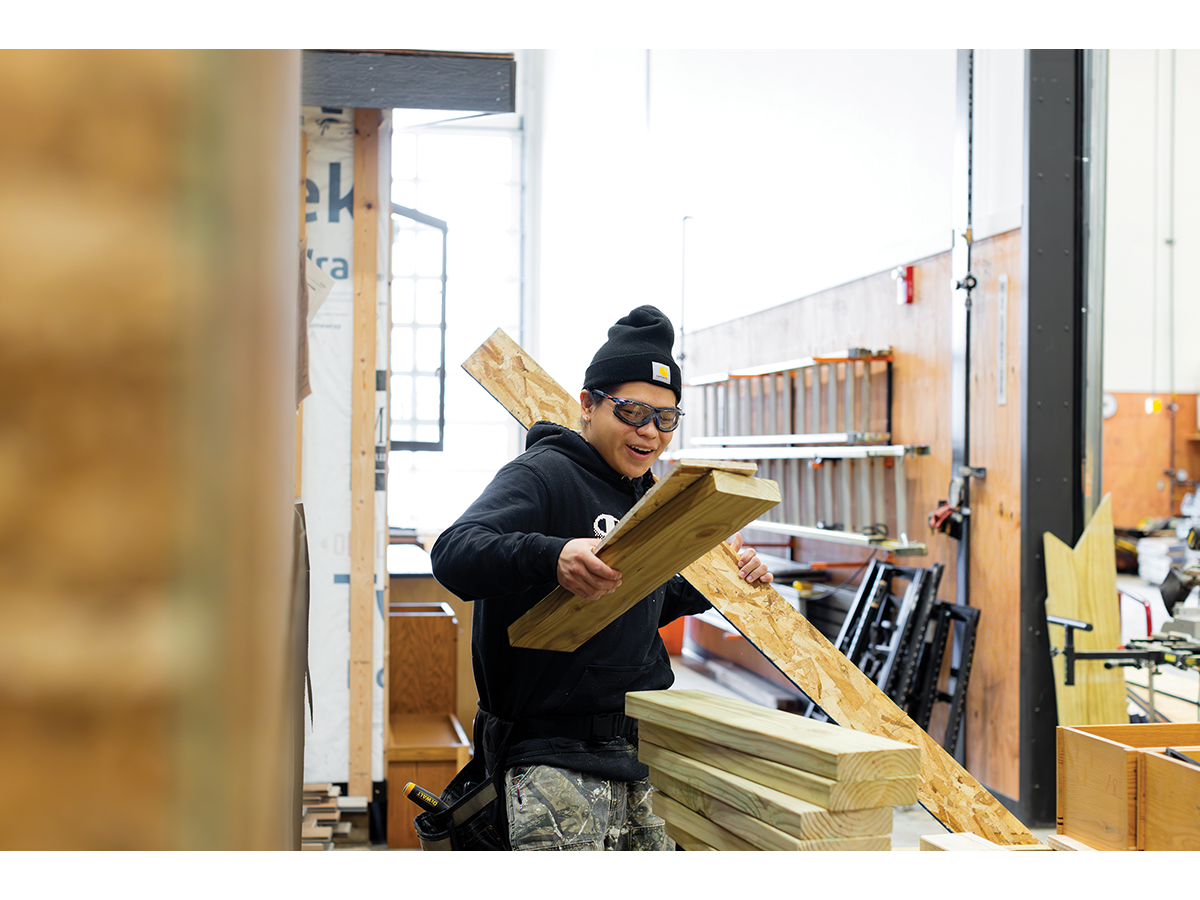
Speaking at the official opening of the space in November, Lucas White, Madison College’s dean of technologies and trades, underscored the potential the new C&R facility has to increase program enrollment, helping to meet a critical demand for workers in Madison and across the state.
“This space … (is) designed to support growth, innovation and development of future carpenters and construction workers,” he said. “This project has been many years in the making … bringing together faculty, staff, industry partners and community members to envision a space that not only supports today’s learners but also anticipates the needs of tomorrow’s workforce.”
White noted that across Dane County and Wisconsin, the demand for professionals in carpentry and construction far exceeds the supply.
“In 2024, the Madison College district alone, which serves parts of 12 different counties … averaged 75 job openings per month, when the national average for an area this size is 14 job openings per month,” he said.
“Also keep in mind, 20% of current carpenters working in Madison College’s districts are 55 years of age or older, highlighting that retirement is another factor that will be impacting this industry.”
Madison College plans to open an evening cohort of C&R in fall 2026 — where historically only two daytime cohorts have been offered — so the move has the potential to boost enrollment in the program by 33%.
That means “more students trained, more graduates entering the workforce … directly impacting economic development and growth,” White said.
Trapp emphasized the partnership with the college has helped meet the needs of his company and that the C&R program is essential to attracting more workers to the field.
The caliber of the new facility better matches the caliber of program instructors, he said, offering not only more space, but better tools and student engagement opportunities.
“The program instructors were doing a great job before,” he said, “but it was kind of like a skilled carpenter who can use outdated, inferior tools and still produce a great product, but it takes a lot longer. … Now, they’re going to be more efficient, have more students, more outreach, more promotion and help more industry partners.”
Better days ahead
Looking ahead, C&R program director Stephany said the new facility will help enhance the program and extend its community reach.
“The trades are a wonderful way to make a living,” he said. We need workers. … Before we had students working in the rain and snow … and we kept saying, ‘Hey, we need a better facility.’ And the college finally said, ‘Yes, let’s do this.’”
The C&R program’s increasing enrollment rates mean more nontraditional students will be served. Stephany pointed to Madison College’s partnership with the Department of Corrections as an example.
“We have a cohort of Department of Corrections students because one of the great things about construction is it doesn’t matter what your background is,” he said. “There are employers who will hire you. They’re ready and they’re willing.”
The ReEntry Skilled Trades Program through the DOC provides education and job training to incarcerated individuals so that once their time has been served, they have skills to help them find employment.
Students can pursue education in electrical maintenance and carpentry techniques through this program.
The DOC pays for their tuition and other costs, and the Workforce Development Board of South Central Wisconsin helps students find jobs afterward.
The new facility will also mean a better space for camps held in partnership with Girl Scouts to train young women in the trades, and Stephany said the college is in talks with the Madison Metropolitan School District about youth apprenticeship training as well.
“With this new, incredible place … we can expand opportunities,” he said. “This is something we’ve dreamed of. Now these students can feel like they belong to Madison College.”
Beth Giles, Madison College provost, added that the benefits the new building and expanded programming will provide to students go beyond educational opportunities.
The program “will teach our students so much more than just bricks and mortar, or trusses,” she said. “Construction and remodeling have the potential to uplift communities and create opportunities for people to make a living wage and progress swiftly and steadily toward the lives they dream of.”
She said the facility’s close mirroring of a real jobsite will prepare students for early success when they obtain employment.
“This space is a testament to what’s possible when we invest in relevant and responsive hands-on learning,” Giles said. “This beautiful building is about building futures. … We know employers are looking for skilled, job-ready professionals, and we know our students are eager to step into those roles.”

