
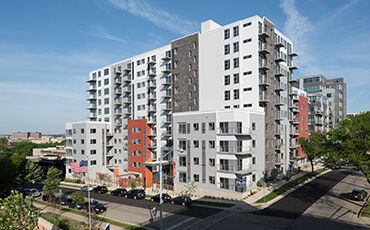

If good things come to those who wait, the recently completed Capitol West development in downtown Madison must be outstanding.
Ten years. That’s how long it took the project to reach completion, and it saw its fair share of turbulence along the way. From Hurricane Katrina impacting construction costs at its outset to the Great Recession changing the way people look at home ownership, Capitol West took its lumps. However, what emerged is still strongly aligned with the original spirit of the project and even stronger because of its trials, says Joe Alexander, president of The Alexander Company, which spearheaded the development.
When The Alexander Co. was selected in 2004 to lead the redevelopment of what were the original Meriter Hospital and Jackson Clinic locations just off the Capitol Square, Alexander says it was exciting but also daunting.
“The opportunity to shape a full city block in downtown Madison is pretty rare,” Alexander notes. “There are few, if any, development locations available anymore within three blocks of the Square. So we brought together planners, three different architectural firms, and our own in-house staff, and brainstormed for a few days on what kind of imprint we wanted to put on downtown Madison. What came from that was an ambitious proposal for more than 350 housing units, some retail space, and reusing the existing Jackson Clinic office building for new office tenants.”
At the time, Alexander says, the condominium market was humming, so that was the use The Alexander Co. focused on for the residential spaces when they got started. It was also right around the time Hurricane Katrina struck the Gulf Coast region of the U.S.
“In real estate there are so many variables,” notes Alexander. “It’s not just supply and demand, it’s also interest rates and weather. As we were bidding the project Hurricane Katrina hit, which drove up the cost of construction and we had to go back and sharpen our pencils on the first part of the project, which was the Broom Street Lofts and the Capitol West building at 309 West Washington.”
Ultimately both of those buildings were completed and opened in 2007 and 2008, respectively.
(Continued)
Changing course
The next phase of the Capitol West development was affected by a disaster of a different sort: the Great Recession.
The economic downturn that began in 2007 spilled over into the next few years. To a degree, its affects are still being felt today, Alexander says.
“The next phase was originally going to be all condominiums,” Alexander explains, “but that ended up becoming the Hyatt Place hotel. During the recession that was a project we were able to get done, so we took advantage of that opportunity.”
The final phase of the project was the Residences at 306 West (Main Street), consisting of high-end apartments, which was completed on May 1.
“Again, not condominiums,” notes Alexander, “but a project this large and ambitious has to change as the world turns. This was an opportunity to finish it off and meet our vision, even if the uses were a little different.”
Alexander says the diversity of housing now available as a result of the way the project changed ended up being one of its greatest strengths.
“Ultimately the condo project at Capitol West was a success. It took more time to absorb than any of us wanted, but everybody who lives there is really happy and gets out to take advantage of downtown Madison, which was the idea from the beginning.
“As we entered a softer phase of the recession, a lot of people changed their lifestyle choices as a result of the way the recession impacted them” Alexander continues. “Not as many people are interested in home ownership as they were even 10 years ago. The opportunity to build really high-end, high-quality condo-level apartments presented itself and that kind of project still met the spirit and intent of the original full-block Capitol West development. We were able to develop 306 West and we’re finding the interest there really is the people who were previously the demographics of the condo market. We’re seeing people of all ages and incomes come to live in the building, but it’s most focused around young professionals and people who have gotten their kids out of the house.”
Impacting the neighborhood
The 172 luxury units of the Residences at 306 West sit atop a stylish grand lobby and entrance portico, giving downtown Madison shops and restaurants well over 200 potential patrons.
Units range in size from 650 to 1,900 square feet, and Tim Bizjak, project manager for builder JP Cullen, says their architectural flair includes two distinct finish packages (cosmopolitan and modern), large windows, and cantilevered balconies that come complete with gas grill hookups and will allow residents to enjoy lake views. “They are not exactly like the condominium units at Capitol West, but they are similar in terms of the high-end quality finishes,” Bizjak says.
And the price point for the apartments is a lot easier to swallow for ownership-averse residents. Whereas the condominium units at Capitol West range in price from $150,000 to $950,000, the apartments at 306 West are available from $1,300 to $3,500.
Located two blocks from the Capitol Square, the 12-story facility is also very Madison-centric, with bike-friendly amenities such as extensive bicycle parking and an indoor bicycle service station; pet-friendly amenities like an indoor pet-washing station; and people-friendly offerings such as a 24-hour fitness center, an electric-car-charging station, and a large private courtyard featuring an outdoor fireplace and sunscreen arbors.
In the end, the development brought about $150 million worth of investments into downtown Madison, Adam Winkler, development project manager for The Alexander Co., says, and resulted in approximately 100–200 construction jobs during each phase of the project.
“The idea is downtown Madison is a walking — and a welcoming — community,” Alexander says, “so we didn’t just want to build a series of towers with intercoms on the front door. In fact, between building entrances and private home entrances, there’s a couple dozen front doors on this block.
“The real impact is when you bring people to live downtown, you see the economic benefit of those people as consumers who support local businesses and restaurants,” continues Alexander. “I think as downtown has changed over the last 15 years and become such an attractive place for people to live, you’ve seen some really great local businesses spring up and be able to thrive.”
Click here to sign up for the free IB ezine – your twice-weekly resource for local business news, analysis, voices, and the names you need to know. If you are not already a subscriber to In Business magazine, be sure to sign up for our monthly print edition here.

