
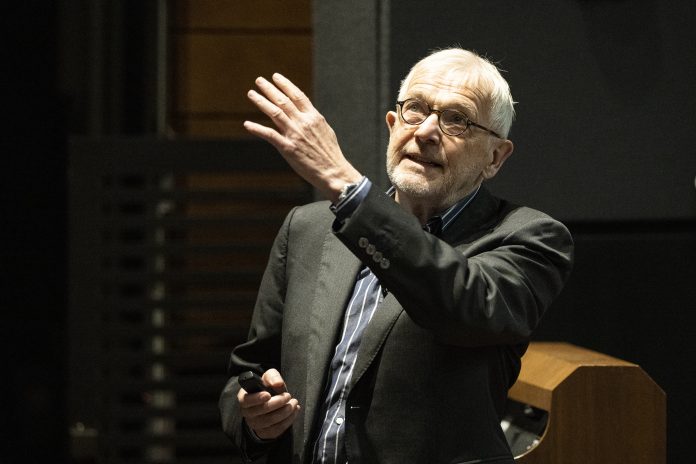

For his groundbreaking work detecting high-energy particles from deep space from a telescope under a mile of ice in Antarctica, UW-Madison professor Francis Halzen and an international team of researchers have won the 2026 Nobel Prize for physics, the Nobel Committee for Physics announced Tuesday.
The high-energy particles, known as neutrinos, are everywhere, but they do not make themselves known. They can pass through the Earth and through our bodies without us noticing.
In the 1980s, Halzen realized that ice at the South Pole could be used to track such particles. His idea eventually gained the support of other researchers and preliminary testing was conducted on sensors in ice.
His scientific leadership has been instrumental in the work done with the IceCube Neutrino Observatory, a telescope equipped with thousands of light sensors embedded in a cubic kilometer of ice.
Using IceCube, researchers captured neutrinos from extremely energy-rich processes in the distant universe.
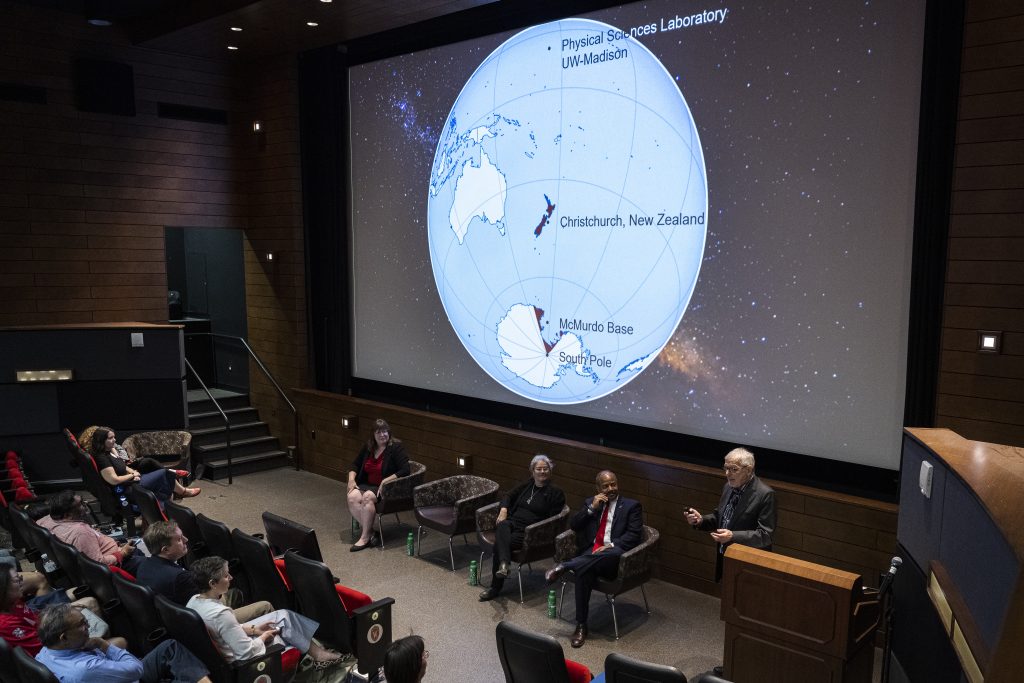
“This is a celebration of a very unusual project,” Halzen said in a press release. “It is difficult to imagine that we could have pulled this off anywhere but at UW–Madison with its unique research infrastructure. The success of this project involved some luck, and I was fortunate to be at UW, where unconventional ideas can thrive and where I had the support of a remarkable community, from talented engineers at the Physical Sciences Laboratory to long-time colleagues on the faculty and supportive administrators.
“It is hard to imagine this project happening anywhere else.”
According to the Nobel Committee for Physics, the neutrino interactions continuously collected by IceCube will provide researchers with novel information about the violent environments in which high-energy neutrinos are created — and possibly reveal new cosmic phenomena.
“Francis Halzen has led an international team of researchers and engineers who have provided us with a fantastic instrument,” Mark Pearce, chair of the Nobel Committee for Physics, said in a press release. “His tenacity and scientific vision has paved the way for a new kind of astronomy.”