
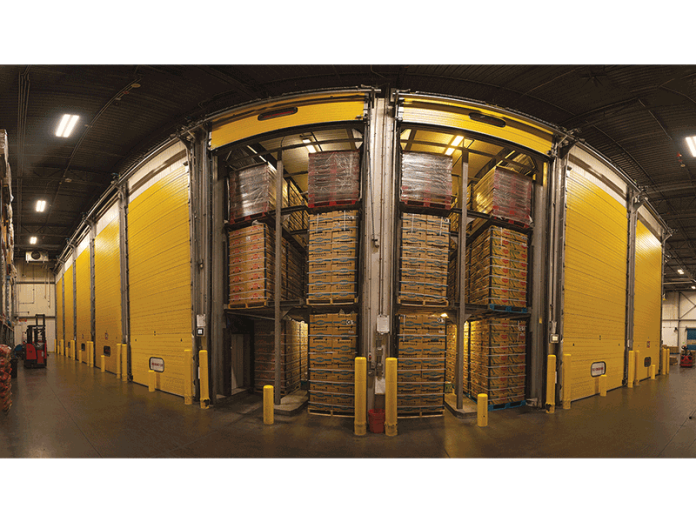

Among the facilities at Kwik Trip’s headquarters in La Crosse as well as its new distribution center in DeForest are banana ripening rooms.
As the name suggests, the rooms are used to hasten the ripening process and are a common practice among food retailers, according to Kwik Trip’s President and CEO Scott Zietlow.
“Every banana sold in this country goes through a ripening room process,” he said. “Nobody lets them ripen on their own. They’ll all spoil or they won’t ripen, and so it’s a very processed type of thing.”
Zietlow said the bananas sold by Kwik Trip are purchased on the futures market and come from Central America through two southern ports, either Port Houston or the Port of New Orleans. They are picked when green, shipped to those ports, Zietlow said, and transported by truck or train to grocery operations in the U.S.
It takes 10 to 14 days for bananas to reach Kwik Trip after they are picked in Guatemala, Honduras or Costa Rica. The company receives about 20 loads of bananas per week and 20,000 cases are shipped out to its stores per week. In all, 42 million pounds of the popular fruit were shipped to Kwik Trip last year.
The 485,000-square-foot distribution center at Kwik Trip’s La Crosse headquarters contains 10 ripening rooms where ethylene gas is used to help the ripening process, another common practice.
“It’s a gas that enhances that process, and they have to be kept within a certain temperature range,” Zietlow said. “We send out two different ripened stages of bananas because some people like them more ripe, and some like them less ripe, and then we deliver generally six days a week.
“They go out every day and we sell a lot,” he said. “We sell about 120 pounds of bananas per store, per day.”
With that many bananas to store, the rooms are necessarily tall spaces aligned next to one another — which, of course, are the color of bananas. The structure containing the rooms is situated inside the distribution center and the bananas are kept behind automatic doors.
The ripening rooms are used mainly for bananas, but the sheer volume of banana sales justifies the investment in storage.
“Bananas are funny that way,” Zietlow said. “They require that process because if they ripen on their own where they are growing, they can’t get transported quickly enough to where they’re going to be consumed before rotting.”

