
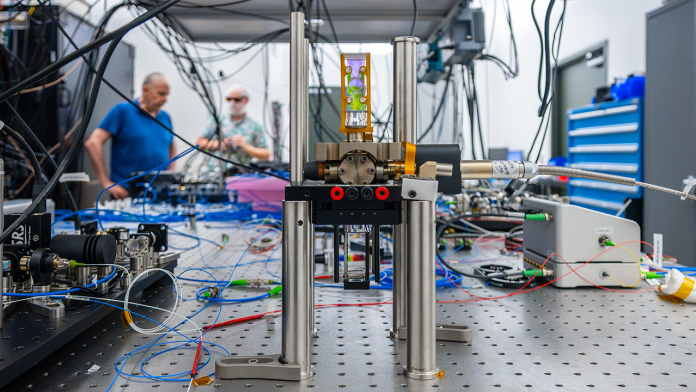

Quantum innovation is nothing new to Mark Saffman — a physics professor at the University of Wisconsin-Madison who has conducted research on a key technology behind quantum computing for over two decades — but he believes the competition for capital and talent is hotter now than ever before.
Since 2018, Saffman has been on the leadership team of Infleqtion, a Colorado-based quantum company that went public in February and has offices in Madison, Chicago and across the globe. The company uses neutral atom technology, Saffman’s specialty, for quantum computing, networking, sensing and security.
Neutral atoms function as the building blocks for quantum computing and sensing — much like the foundational “bits” of traditional computers. But quantum computers have the potential to solve problems of exponentially higher complexity than conventional machines.
Infleqtion isn’t the only company making cutting-edge advancements on Madison’s burgeoning quantum scene. QoLab, co-founded by another UW-Madison physics professor, is working to increase the superconducting capacity of quantum bits, known as ‘qubits,’ to allow for immense computing power.
And Dirac Labs, founded by a UW-Madison graduate student, is developing quantum sensors to support navigation that is independent of satellites. Like a compass, these sensors use Earth’s magnetic field to navigate, but with ultra sensitivity.
The heart of the local quantum ecosystem is innovation coming out of UW-Madison, according to Greg Keenan, partner at the Wisconsin Alumni Research Foundation’s venture fund, WARF Ventures, which has invested in both Infleqtion and QoLab.
Keenan said collaboration among local and nationwide partners to drive quantum technologies forward, secure key investments and scale up promising companies will be critical to remaining globally competitive.
“We have some of the strongest quantum research on the planet at our university,” Keenan said. “We have organizations like WARF that can further support scale-up and commercialization. We’ve partnered with the Chicago Quantum Exchange, so that’s bringing additional capabilities — not just to us, but to the entire United States.
“We’re accessing capital in Silicon Valley and in Boston and New York. … There’s that local competition (for) talent and dollars, but more important is the collaboration across all of these ecosystems to position us to be more competitive than China in our space.”
The Wisconsin Quantum Institute, which connects all quantum research on the UW-Madison campus, and the newly formed Quantum Alliance — launched by the Wisconsin Technology Council in June — are working together to strengthen the state’s position in the quantum world and heighten its appeal for new workers and companies.
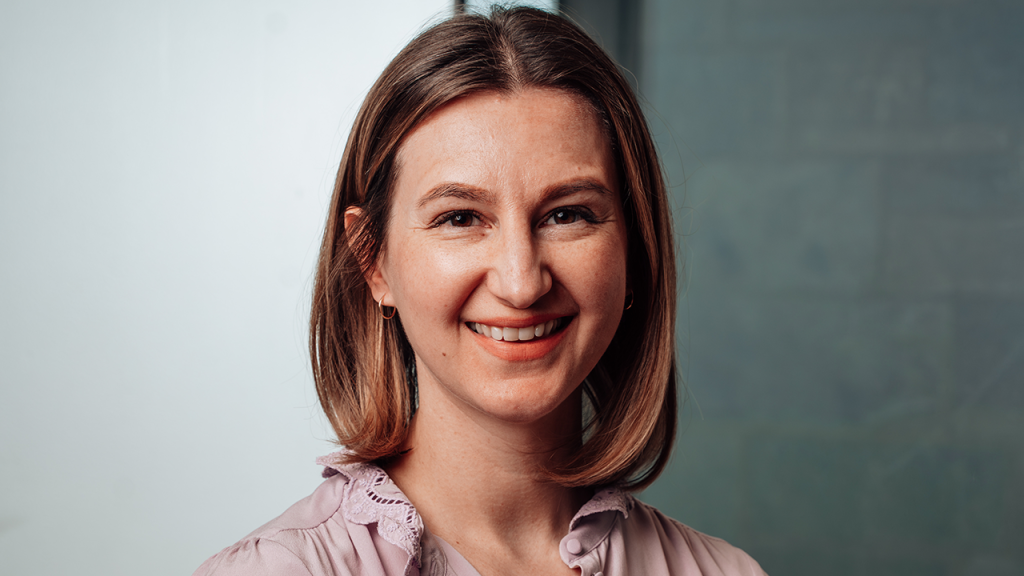
“The goal of the Quantum Alliance is to engage partners across higher education, workforce, industry and government to pair them with those other assets to create a unified ecosystem around quantum in Wisconsin,” said Maggie Brickerman, Tech Council president. “No one institution can do that alone. So, the goal of this was to start to… raise awareness about the opportunity that Wisconsin has, and to engage all of those different assets in creating the workforce, including engaging the supply chain, getting the state government’s support, helping industry understand that there are interesting applications that will benefit them … so it’s all kind of a symbiotic ecosystem.”
An emerging industry
Recent data makes a case for the economic opportunities in quantum — particularly for the Midwest. Boston Consulting Group in 2024 forecast that the quantum computing market will create $450 billion-$850 billion of global economic value by 2040 and sustain a $90 billion-$170 billion market for hardware and software providers.
And as of 2023, despite a drop in overall tech investments, quantum computing attracted $1.2 billion from venture capitalists.
In May, the Chicago Quantum Exchange reported that in the Illinois-Wisconsin-Indiana region alone, universities collectively graduate roughly 2,200 doctoral students and 14,000 master’s students annually in disciplines relevant to quantum technologies.
And a National Science Foundation analysis projects the emergence of 80,000-191,000 quantum-related jobs across the three states by 2035. They will span research, engineering, manufacturing and supporting technical occupations. Over 70% of these roles are anticipated to be accessible without a graduate degree.
Brickerman said capturing the economic benefits of the rising quantum industry necessitates statewide and regional cooperation, and she sees Wisconsin playing a leading role.
“It has to be sort of a … multi-sector, multi-profile effort to build a strategic plan and get after it,” she said. “We need all these partners talking to each other because … (the industry) is emerging, and if we wait until it’s not emerging, we’ll miss the opportunity.”
The Quantum Alliance includes associations such as BioForward, the Wisconsin Farm Bureau Federation, Wisconsin Manufacturers & Commerce and both Madison and Milwaukee’s chambers of commerce; higher education institutions including foundational partners UW-Madison and UW-Milwaukee, as well as Madison College, UW-Stout Polytechnic, Marquette University, UW-Green Bay, UW-Parkside and Waukesha County Technical College; players on the investor side such as gener8tor and TitletownTech; and state agencies like the departments of Administration and Workforce Development and the Wisconsin Economic Development Corp.
At UW-Madison, the Wisconsin Quantum Institute is leading an effort to bolster campuswide quantum research to encourage the development of new companies and propel innovation.
“UW-Madison has been investing in the development of quantum technologies for over 25 years,” professor Mark Eriksson, director of the Wisconsin Quantum Institute, said in a statement. “Today we are proud to be considered a global leader in quantum technology research with over 50 quantum-aligned research faculty, $20 million in annual federal funding, 100 PhD graduates and the first quantum Master of Science program in the US. In addition, we are proud to be a research hub for multiple venture-capital backed quantum companies.”
He said Wisconsin’s combination of industry, community, civic and academic strengths can position it as a leader in a future economy shaped by the rise of quantum technologies.
“Quantum computing offers the ability to solve problems that supercomputers and AI currently cannot solve,” Eriksson said in a statement. “Quantum sensors offer sensitivities far greater than current solutions; and quantum communications offer pathways to … advances in communication security.”
He added that quantum-enabled capabilities will open doors in core Wisconsin industries such as biotechnology, agriculture, manufacturing, energy and financial services.
And with growing government funding for quantum technologies over the past decade and billions of dollars available through multiple federal funding agencies, there are “increasing funding opportunities for regional ecosystems focused on quantum education and training, supply-chain development, commercial-readiness and infrastructure,” he said.
“Wisconsin is well positioned to benefit from this federal support and develop into an economic hub for quantum technology.”
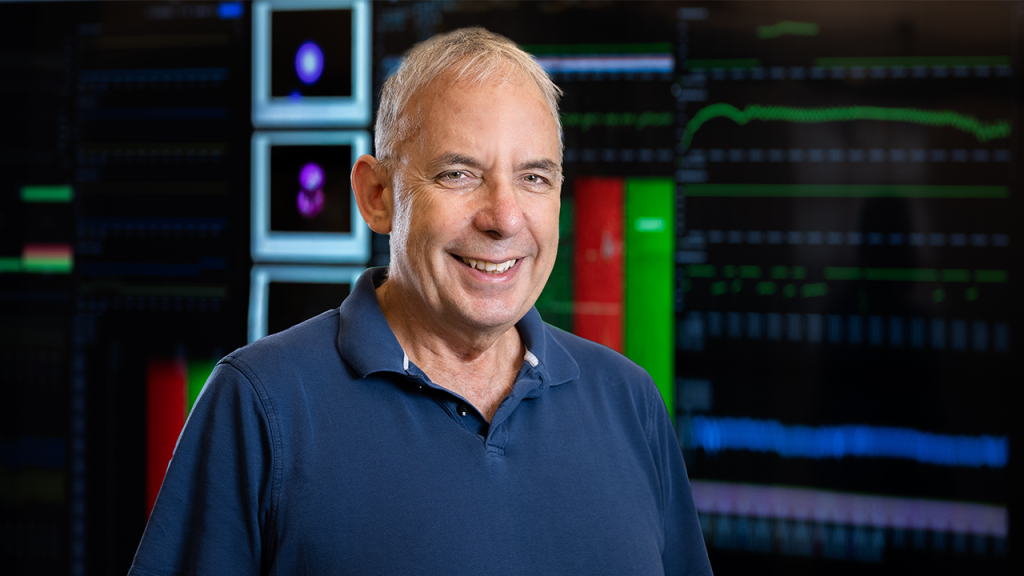
Photo: Beau Meyer
The Infleqtion point
As campus- and statewide partners fuel quantum innovation, companies like Infleqtion are focusing on its practical applications.
Infleqtion evolved from a collaboration between UW-Madison’s Saffman and University of Colorado professor Dana Anderson, the founder of the company’s 2007 progenitor, ColdQuanta, and Saffman’s former Ph.D. adviser.
“It was clear it wasn’t just science, but we could actually build something that had practical use here,” said Saffman, who is now Infleqtion’s chief scientist for quantum information.
He said Infleqtion’s focus on multiple quantum applications distinguishes it from peers whose technologies may only apply in certain markets — a competitive strength that has catapulted the company from university spinout to global enterprise.
“When people talk about quantum technologies, there are generally three areas… one is quantum computing, one is quantum networking — that is secure transmission of data and connecting quantum computers a long distance … and then quantum sensing, being able to do things like navigate very precisely without relying on GPS, which is susceptible to spoofing and disruption.
“Infleqtion is unique in that atoms can be used for computing, networking and sensing … and I’d say that’s both a strength, but also a challenge.”
Saffman noted that the use of individual atoms for making quantum bits, or qubits, originated in Madison.
WARF — UW-Madison’s technology transfer office — licensed the underlying technology Saffman brought to Infleqtion and invested in the company through its venture fund. Infleqtion was the first company to exit the WARF Ventures portfolio and, armed with new capital, the company is on the cusp of breakthroughs that could transform areas like cryptography — cracking codes today’s computers cannot.
“As a public company we can… expand deployments in areas such as aerospace, defense and critical infrastructure,” Matthew Kinsella, Infleqtion’s CEO, said in a statement earlier this year.
While quantum computing is expected to offer numerous high-stakes applications, Saffman said it’s impossible to know everything these new computers will be able to do until they are built.
WARF Ventures’ Keenan said such advancements represent the “second phase of quantum.”
“The first phase of quantum… was kind of at the macro scale — using quantum mechanics to describe phenomenon, and now the second phase of quantum is actually using quantum mechanics to do these things like computing,” he said. “The security systems that we’re using on our phones and computers — a regular computer today (lacks) the horsepower to crack those. Quantum computing can … so that’s how powerful this will be.”
He added that rather than replacing traditional computers, quantum computers will complement them.
Keenan said federal funding that drives the basic research underpinning such innovations has remained fairly stable but must continue to grow.
“If we want to maintain competitiveness with China, we need to be doing more, faster,” he said. “We need to increase our investments in … universities, our national labs and then our startup companies that are commercializing these technologies.”
National Science Foundation programs through the departments of Energy and Defense, and the Small Business Innovation Research program all provide essential funding for quantum research and university spinouts, he said, which in turn will fuel one of the most pivotal technological shifts in recent history.
“Quantum computing … is going to be as big, if not bigger than, AI,” said Keenan. “How do we get (quantum technologies) out of the lab? … How do we engineer the hardware in a way that you can scale it and make it cost-effective? … How do you develop software … so that everyday users can use the technology? That’s the reason we should be investing in it now.”
In June 2025, Infleqtion announced a $100 million Series C funding round, having generated almost $30 million in revenue over the previous year.
Since 2018, WARF has made multiple investments in Infleqtion, and Keenan said its debut on the New York Stock Exchange this past February proved that capital was allocated wisely.
“We were able to get a return on our investment, and I think it’s really important that we look at this story and say, this (is what) happens at this university — in fusion, in therapeutics and all areas that impact our state and folks around the world,” Keenan said.
Saffman said going public “put around $550 million of cash in our books and positioned us for the next stage of growth.”
This past May, the company also signed a letter of intent with the U.S. Department of Commerce’s CHIPS Research and Development Office for $100 million in proposed funding, contingent on reaching development milestones to propel U.S.-based quantum computing technologies.
In addition to its Colorado, Madison and Chicago offices, Infleqtion has a computing and sensing team in the United Kingdom at Oxford, and smaller offices in Australia and Japan. Saffman said Madison’s hiring pool makes the case for maintaining a presence here.
“If you look at what’s going on in quantum computing, and this very intense competition with many startup companies… the most difficult rate limiting factor is hiring talent,” he said.
Homegrown tech, broad potential
Madison’s QoLab and Dirac Labs are two other local quantum companies fueled by university innovation and experiencing recent growth.
QoLab — co-founded by UW-Madison physics professor Robert McDermott, 2025 Nobel Prize in Physics recipient John Martinis and Alan Ho, the former head of product at Google Quantum AI — is working to develop quantum computing hardware, namely, superconducting quantum processors.
McDermott said it starts with making “better qubits” that can be integrated into large-scale systems.
“We are partnering with the leaders in the semiconductor industry to make superconducting qubits using unique tools and fabrication processes that are much more advanced than what is done currently, even in major companies like IBM and Google,” he said. “We’re addressing the fundamental limits to these devices … getting rid of the defects that are causing the devices not to perform as well as they should.”
McDermott said while QoLab is a small company in comparison to Google, Amazon or IBM, he’s confident in the path his team is pursuing to building a quantum computer — but it will require additional capital.
“I think to build a practical quantum computer that can outperform a supercomputer is going to take over a billion dollars, maybe a couple billion dollars,” he said. “Will we continue to be able to raise money at the right pace in order to build out a full system?
“There are technical challenges, certainly, but … we’ve got a very deep understanding of what it takes to make a system perform well, and we are working with some very large companies with deep pockets. That’s why I think we’ll be able to move quickly.”
He said within a couple of years, he expects QoLab to have developed small-scale quantum processors that are “scientifically interesting,” while a system that’s “more generically useful” from an industry standpoint could be five to 10 years out.
In early July, QoLab announced that it had secured $54.2 million in Series B financing. The round, led by UC Investments, also included existing financial and strategic semiconductor investors like WARF, Octave Ventures and Phoenix Venture Partners.
Another local quantum company, Dirac Labs, spun out of UW-Madison in 2023 and is developing highly precise navigational quantum systems that are independent of GPS. The startup’s team of four people is seeking venture capital to allow it to scale.
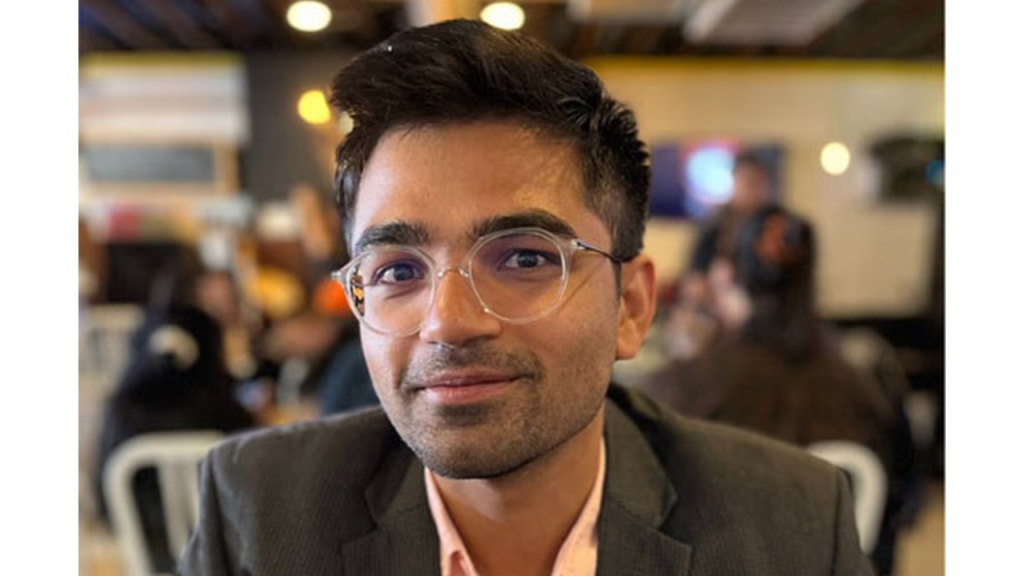
“I’ve been startup-focused for a while,” said co-founder Sanket Deshpande, who said growing up in India in a household without electricity inspired him to build a company that could change people’s lives across the globe.
“Founding Dirac, I was like, OK, this is the last frontier of making quantum more feasible, or more commercializable,” he said. “Today, the way we navigate is you need a satellite to tell you where you are … or you’re always relying on something external. Our vision was, navigation is so tied to exploration, which is a human need.”
He compared Dirac Labs’ technology to the invention of the compass hundreds of years ago.
“We’re back full circle, and what we are doing is again using Earth’s magnetic field to navigate, but in this case we just have a highly sensitive compass, which can detect tiny magnetic field variations caused by different geological structures … and not just that. Buildings create magnetic fields, electricity poles, things like that.”
He said the goal is to make the technology broadly applicable — for instance, in aircrafts, on mobile platforms, in cars or drones. While classical sensors have existed with the same level of sensitivity, he added, they typically need refrigeration or large amounts of electricity, or are extremely fragile, so quantum sensors could be more commercializable and lower-cost.
Going from idea, to prototype, to market is a challenge, Deshpande said, but his startup has been able to leverage university resources and outside expert support.
“WARF has this new initiative — they set up this Third Coast Foundry in San Francisco that gives us access to investors and the startup community in the Bay Area. … Those things have definitely been a critical component of getting us to this stage.”
Third Coast Foundry is a physical space in San Francisco for university-founded startups and teams traveling to the Bay Area. It was launched by WARF and UW-Madison in partnership with other universities like Carnegie Mellon, Northwestern, the University of Chicago and others.
Dirac Labs recently won the Wisconsin Seed Award through the state for its translation of some of the intellectual property developed by its scientific advisers into a commercial product.
On the company’s Instagram page, the team’s Magnetically Mapping Madison series shows a tiny rover driving around to test the company’s sensors and map the city’s magnetic fields.
“We expect to do more tests on various platforms — ground, air and sea,” said Deshpande. “And because we have freshwater lakes… around us, we will be doing more tests underwater in this region. We actually took this rover on the frozen Lake Mendota during the winter and mapped the lake’s magnetic field.”
The technology has several high-priority applications, in such areas as military defense, but Deshpande also wants to bring it to the larger commercial sector to make agricultural platforms more resilient, improve the automotive industry, make the mining sector safer and benefit factories and warehouses that would be improved by better positioning systems.
“We have partnered with several players in the industry to actually embed it in their platforms directly, instead of offering it as a standalone product,’ said Deshpande. “So, you’ll see some of that happening over the next year or so.
“When you think of quantum, (you think of) some scientists in a lab, but not really,” he added. “It’s people out in the real world.”

